
Commercial Site Preparation in North Missouri
Full-service commercial excavation, mass grading, utility infrastructure, drainage systems, structural building pads, and construction-ready site development. We help developers, general contractors, municipalities, and commercial property owners transform raw land into cleared sites, properly graded pads, and utility-ready infrastructure designed for long-term performance and efficient construction sequencing.
Serving Chillicothe, Cameron, Trenton, Bethany, St. Joseph, Maryville, Kirksville, Brookfield, Macon, Moberly, and commercial development projects throughout North Missouri.
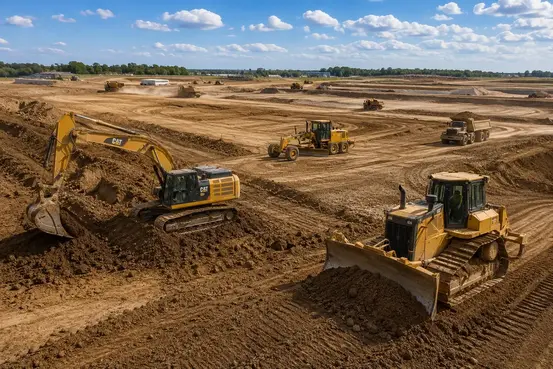
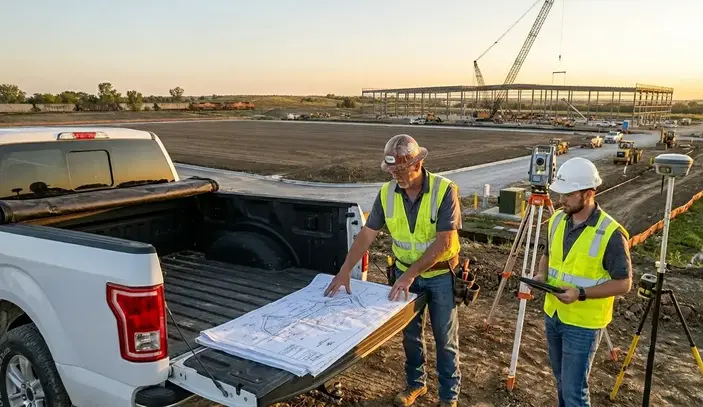
Successful commercial projects are built on planning, not assumptions. Proper site evaluation identifies drainage, soil, elevation, and grading challenges before construction begins.
Before We Move Dirt, We Determine If Your Site Is Actually Build‑Ready
In commercial development across North Missouri, the biggest delays rarely come from the work itself. They come from sites that were never evaluated properly before excavation began. A pad can look dry and level on the surface while hiding soil, drainage, or balance issues that will stall a project weeks later.
That’s why we don’t guess. Before pricing or scheduling equipment, we evaluate the conditions that decide whether your project stays on track or ends up with change orders and rework.
- Soil stability under long‑term load We check how the subgrade behaves under moisture swings and structural weight, not just how it looks on a dry day.
- Drainage behavior during real weather North Missouri ground can shift fast in heavy rain. We identify natural flow paths that will undermine pavement, pads, or utilities if they aren’t addressed early.
- Accurate cut/fill balance A miscalculated balance leads to costly import/export cycles. We verify volumes so you’re not paying for unnecessary haul‑off or truckloads of fill.
This early evaluation is what separates predictable commercial builds from projects that keep getting pushed back once construction is already underway.
What Makes A Commercial Site Construction Ready
A build-ready site is more than cleared ground. Every commercial project depends on stable soils, controlled drainage, and elevations that align with engineered plans. If any of these elements are overlooked, the problems often appear later during foundation work, utility installation, paving, or inspections.
- Soil Stability — Supporting structural loads without excessive settlement or movement.
- Drainage Performance — Directing stormwater away from buildings, pavement, and utility infrastructure.
- Elevation Accuracy — Ensuring foundations, utilities, roads, and drainage systems all work together properly.
- Cut And Fill Balance — Reducing unnecessary hauling while maintaining design grades.
This evaluation process allows construction to begin on predictable ground instead of discovering problems after expensive work is already underway.
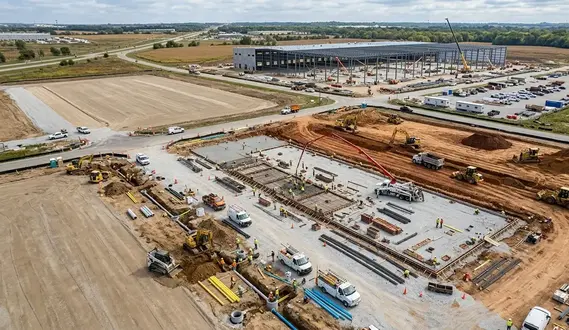
Commercial site preparation impacts every contractor that follows. Proper sequencing keeps foundations, utilities, inspections, and construction schedules moving forward.
Not Sure If Your Site Is Actually Build-Ready?
Before grading begins, we evaluate drainage behavior, soil conditions,, elevations, access, and earthwork requirements to identify issues that could delay construction later.
Schedule A Site EvaluationCommercial Projects Run On Timelines, Not Just Dirt Work
On every commercial job, one truth holds: every contractor depends on the one before them. When site preparation slips, the entire schedule shifts with it.
Concrete crews lose pour dates.
Utility contractors miss mobilization windows.
Material deliveries get rescheduled.
Inspections move out.
Financing milestones can be affected.
That’s why commercial excavation is more than moving dirt efficiently. It’s about creating predictable, stable conditions so the next phase of construction can begin without surprises.
Our goal is straightforward: When site prep is finished, the next contractor should be able to step on the pad and start work immediately, no soft spots, no drainage issues, no unfinished utilities, no rework.
Commercial development is expensive.
Delays are expensive.
Rework is expensive.
The right site preparation helps eliminate all three.
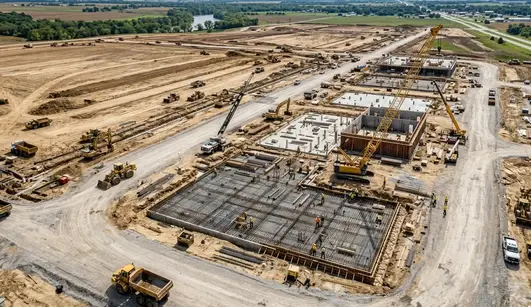
Commercial development starts long before concrete is poured. Every successful project begins with properly prepared ground, drainage infrastructure, and structural sitework.
Working Against A Construction Schedule?
We help developers and contractors prepare sites in the correct sequence so utilities, concrete, inspections, and vertical construction stay on track.
Discuss Your Project TimelineCommercial Site Development Contractors For Ground-Up Construction
Commercial site development is the phase that determines whether the rest of the project moves efficiently or encounters costly delays. Before foundations, utilities, paving, or vertical construction can begin, the site must be properly prepared to support every phase that follows.
Our team works with developers, general contractors, engineers, investors, and commercial property owners to transform raw land into construction-ready sites. From initial clearing and earthmoving through grading, drainage infrastructure, utility corridors, and structural pad preparation, we perform the critical sitework required before building construction begins.
Whether you're developing a warehouse, retail center, manufacturing facility, truck terminal, municipal project, agricultural processing facility, or mixed-use commercial property, proper site development creates the foundation for long-term project success.
- Commercial earthwork and mass excavation
- Industrial site development
- Commercial grading contractors
- Structural building pad preparation
- Utility corridor excavation
- Stormwater management systems
- Commercial access roads and truck routes
- Construction-ready site development
Every successful commercial project begins with a site that is engineered, graded, drained, and prepared correctly from the ground up.
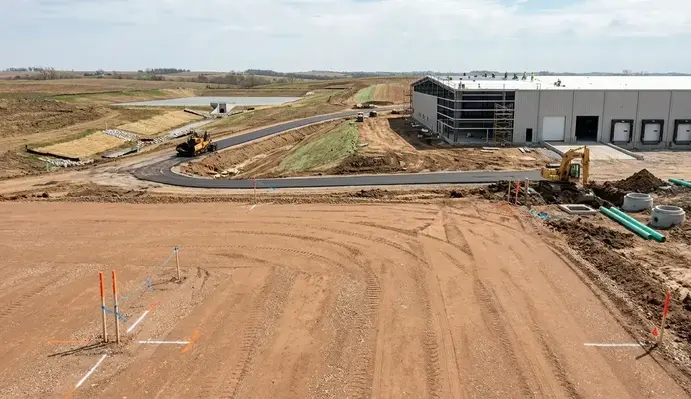
Every phase of commercial site development builds upon the previous one. Proper execution early in the process prevents costly corrections later.
Our Commercial Site Development Process
Successful commercial projects follow a sequence. Every phase builds on the one before it. When site preparation is performed in the correct order, construction moves efficiently, inspections stay on schedule, and costly rework is minimized.
1. Site Evaluation
We review grading plans, drainage requirements, access constraints, utility locations, and existing site conditions to identify challenges before equipment arrives.
2. Clearing & Earthwork
Vegetation, unsuitable material, and obstacles are removed through commercial land clearing while rough grading begins to establish primary elevations and drainage flow paths.
3. Mass Grading
Cut and fill operations are performed to achieve design elevations while maximizing on-site material utilization and reducing hauling costs.
4. Utility Infrastructure
Water, sewer, electrical, gas, and communication corridors are established through precision utility trenching according to engineered site plans and construction sequencing requirements.
5. Building Pad Preparation
Structural pad areas are conditioned, compacted, and fine graded to meet engineering specifications and support long-term structural loads.
6. Final Site Readiness
Drainage systems, access routes, and finished grades are verified so the next phase of construction can begin immediately.
Commercial Development Projects We Specialize In
Warehouse & Industrial Foundations
Engineered subgrade preparation, heavy‑load compaction, and precision grading for industrial structures and distribution centers.
Retail & Commercial Developments
Full site preparation for shopping centers, strip malls, restaurants, and multi‑tenant commercial properties.
Parking Lot Construction Preparation
Proper base grading, drainage design, and compaction for long‑lasting commercial parking infrastructure.
Access Roads & Truck Routing
Engineered access paths designed for heavy truck traffic, delivery logistics, and construction‑phase mobility.
Stormwater & Drainage Engineering
Controlled runoff systems, retention planning, and grading solutions designed to meet commercial compliance standards.
Utility Infrastructure Trenching
Precision trenching for water, electrical, gas, and fiber installation across commercial developments.
Commercial Site Work Services
Commercial site preparation involves far more than grading a piece of property. Most projects require multiple phases of site work to prepare the land for utilities, paving, foundations, drainage infrastructure, and vertical construction.
Our commercial site work services commonly include:
- Mass excavation and earthmoving
- Commercial land clearing
- Structural fill placement
- Building pad construction
- Utility trenching and excavation
- Storm sewer installation
- Retention pond excavation
- Culvert installation
- Parking lot preparation
- Roadway grading
- Construction entrances
- Erosion control implementation
- Final grading and finish work
Whether the project involves a retail center, warehouse development, manufacturing facility, municipal project, or commercial expansion, proper site work creates the foundation every other trade relies upon.
Stormwater Management And Drainage Compliance
Stormwater management is one of the most critical components of modern commercial development. A site must not only function during normal conditions but also perform during major rainfall events.
Improper drainage can lead to erosion, flooding, pavement failure, foundation problems, and regulatory issues.
Commercial grading must account for systems designed in stormwater management and drainage planning:
- Runoff control
- Detention and retention systems
- Swales and drainage channels
- Culvert installation
- Erosion control measures
- Finished site drainage performance
Our goal is to create sites that efficiently move water away from structures, parking lots, roadways, and utility infrastructure while supporting long-term site stability.
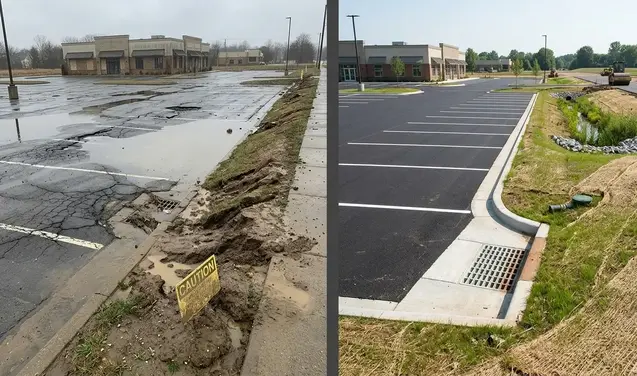
Most commercial site failures begin below the surface. Compaction errors, poor drainage, and grading mistakes often remain hidden until expensive repairs become necessary.
The Most Common Commercial Site Failures And Why They Happen
Most commercial site failures don’t appear during grading. They show up later, after concrete, asphalt, or structural work is already in place, when fixing the problem becomes expensive and disruptive.
In our region, the same preventable issues cause most long‑term failures:
- Improper compaction sequencing Uneven density across structural zones
- Uncontrolled water movement Drainage not established before final grading
- Cut and fill imbalance Unstable imported soils or overworked native material
- Subgrade contamination Unsuitable soils mixed into structural layers
Preventing these issues starts with proper sequencing, clean material separation, and drainage planning before construction begins.
The Cost Of Small Site Preparation Mistakes
Commercial grading errors rarely reveal themselves on day one. They surface only after concrete is poured, utilities are installed, or pavement is placed, when the ground finally reacts to loads it was never properly prepared to carry. At that point, the “small mistake” becomes excavation, demolition, redesign, and schedule disruption.
This is why precision in grading, drainage planning, compaction, and utility coordination isn’t optional, it’s the difference between a site that performs for decades and one that becomes a liability. Correcting a site preparation issue before construction begins is almost always a minor adjustment. Correcting it afterward is a budget‑breaking event.
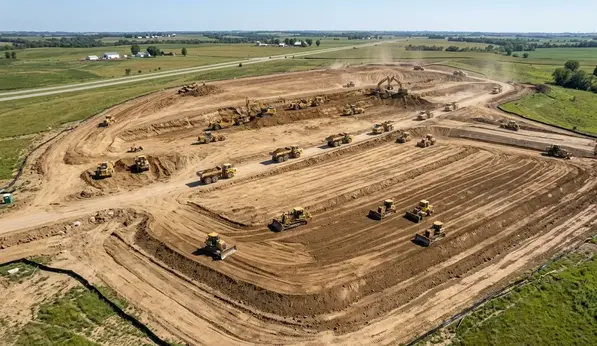
Efficient earthmoving reduces hauling costs, minimizes waste, and creates a more predictable construction budget from the start.
Concerned About Drainage, Settlement, Or Site Stability?
Identifying grading, compaction, and drainage problems before construction progresses can prevent expensive rework and long-term structural issues.
Request A Site AssessmentCut And Fill Optimization Can Save Thousands On Commercial Projects
One of the largest hidden costs in commercial site development is unnecessary material movement during mass excavation and earthwork. Every truckload hauled off-site or imported back onto the project adds labor, fuel, trucking costs, and schedule risk.
That is why cut and fill optimization is one of the most important phases of commercial grading.
The objective is simple: move earth efficiently while maintaining design elevations and drainage performance.
Key benefits of proper cut and fill planning:
Reduce imported fill requirements
Reduce off-site hauling expenses
Minimize trucking delays
Improve grading efficiency
Maintain engineered elevations
Lower overall project costs
The best commercial grading plans don’t simply move dirt, they strategically balance earthwork across the site so materials are used where they create the greatest value.
Why Rework Becomes So Expensive
When grading plans aren’t properly coordinated, material doesn’t just move once, it moves two, three, sometimes four times. Each unnecessary movement compounds costs: additional labor, extra trucking cycles, wasted fuel, accelerated equipment wear, and lost production hours. What should have been a single, efficient cut‑and‑fill operation becomes a chain reaction of avoidable expenses.
The purpose of cut and fill optimization isn’t simply to “move dirt efficiently.” It’s to establish final grades that support drainage, utilities, structural pads, and paving without requiring excavation crews to return later and tear out work that was already paid for. When the site is balanced correctly the first time, the entire project benefits, fewer change orders, fewer delays, and a far more predictable construction sequence.
How Commercial Projects Lose Money Before Construction Even Starts
Most commercial budget overruns don’t start with steel, concrete, or labor. They start in the dirt, long before the first footing is dug. When the ground isn’t understood, measured, or balanced correctly, the entire project inherits those mistakes.
Commercial excavation isn’t just earthmoving. It’s the first and most important risk‑management phase of the entire development. Every unknown left in the soil becomes a cost later, sometimes a small one, sometimes a six‑figure one.
Excess Hauling Costs
When cut‑and‑fill volumes aren’t calculated correctly, trucking becomes a runaway expense. We’ve seen projects burn through budgets simply because no one verified how much dirt actually needed to move before equipment showed up.
Drainage Redesigns
Water exposes every shortcut. If natural drainage paths aren’t mapped and controlled early, developers end up paying for regrading, re‑engineering, and emergency fixes after construction is already underway.
Elevation Errors
A few inches off at rough grade can become thousands of dollars off at finish grade. Incorrect elevations ripple into foundation adjustments, utility conflicts, ADA issues, and stormwater failures.
Utility Conflicts
When utilities aren’t coordinated with grading and compaction sequencing, trenches get reopened, pads get disturbed, and schedules fall apart. These conflicts are preventable, but only if addressed before trenching begins.
Schedule Disruptions
Commercial construction runs on sequencing. If site prep slips, every trade behind it loses time, concrete, utilities, steel, inspections, and deliveries. One missed grade check can push an entire project off its timeline.
Failed Compaction
Poor compaction doesn’t fail on day one, it fails when the slab cracks, the pavement settles, or the building starts shifting. Fixing it later means tearing out work that was already paid for.
The most successful commercial developments aren’t the ones that move dirt the fastest, they’re the ones that eliminate risk early, build stable ground, and give every trade that follows a predictable surface to work from.
Commercial Excavation Investment Overview
Commercial site preparation costs vary based on project size, soil conditions, haul distance, drainage requirements, and engineering complexity. Below is a general investment range to help you plan early-stage budgets.
- Small Commercial Pads: $10,000 – $50,000+
- Retail Developments: $25,000 – $150,000+
- Industrial Mass Grading: $50,000 – $500,000+
- Parking Infrastructure Prep: $15,000 – $200,000+
These ranges reflect typical excavation, grading, drainage, and earthwork requirements. Final pricing is determined after an on-site evaluation, soil review, and assessment of access, utilities, and engineering specifications.
For the most accurate estimate, we recommend scheduling a site evaluation so we can review elevations, drainage paths, and material movement requirements.
Commercial Building Pad Preparation
Every commercial structure, from warehouses to municipal facilities, ultimately depends on the performance of the building pad beneath it. A pad that isn’t built correctly doesn’t fail on day one. It fails years later, when repairs are far more expensive than doing it right the first time.
Heavy commercial buildings demand structural pads capable of supporting forklifts, racking systems, machinery, truck traffic, and long‑term settlement loads. That level of performance doesn’t happen by accident, it comes from a controlled, engineered preparation process.
A properly constructed commercial building pad typically includes:
Subgrade evaluation to identify weak soils and moisture issues
Removal of unsuitable or unstable material
Placement of engineered fill designed for structural loading
Moisture conditioning to achieve optimal compaction
Compaction in controlled lifts to prevent future settlement
Fine grading to precise design elevation and pad tolerances
When a building pad is prepared correctly, foundations perform better, slab movement is minimized, and long‑term structural stability is dramatically improved, protecting the entire investment built on top of it.
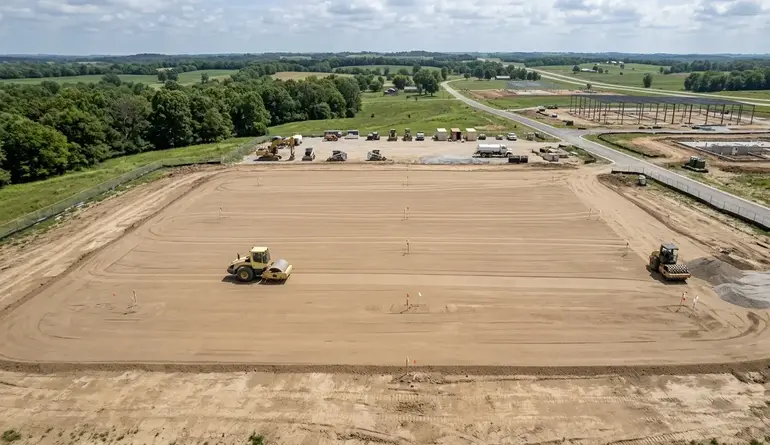
A building pad is more than level ground. It is the engineered foundation that supports decades of structural performance.
Planning A Commercial Building Project?
Before foundations are poured, we evaluate site conditions, drainage requirements, subgrade stability, and building pad specifications to help prevent costly construction delays and future settlement issues.
Call (660) 371-5901Warehouse & Distribution Center Site Preparation
Warehouse and distribution developments place extreme demands on excavation and grading. Heavy truck traffic, loading docks, racking systems, forklift routes, and high‑load slab requirements all depend on a site that is engineered and prepared with precision, not guesswork.
These facilities require precise coordination with engineered building pad construction and full site development planning.
Site preparation for distribution facilities often requires:
Large‑scale mass grading to establish uniform elevations
Heavy‑duty building pad construction for high‑load structural performance
Truck court preparation designed for constant heavy traffic
Loading dock grading with precise elevation control
Stormwater infrastructure capable of handling large impervious surfaces
Commercial utility corridors for water, sewer, electric, and communications
Parking lot and access road preparation
built for long‑term durability
Proper subgrade preparation and compaction are critical in warehouse environments. When the ground is built correctly, slabs stay level, pavements last longer, and heavy equipment can operate without causing settlement or structural movement. In high‑traffic industrial facilities, the pad is not just dirt, it’s the foundation of the entire operation.
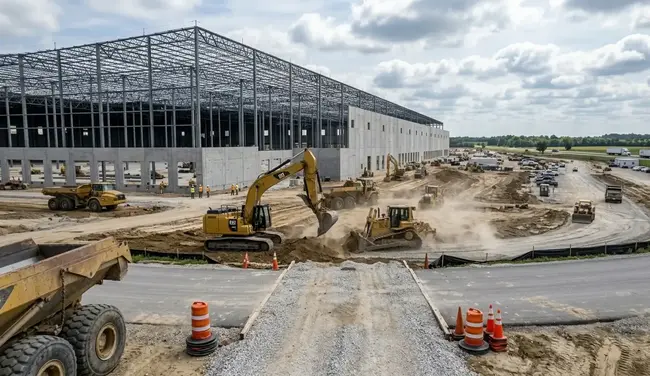
Distribution facilities place enormous demands on site preparation. Precision grading and compaction help support heavy traffic and long-term operational loads.
Built for Developers, General Contractors, and Multi‑Phase Builds
Commercial site preparation isn’t just about moving dirt, it’s about keeping every phase of construction aligned with engineering requirements, inspection timelines, and the overall build schedule.
Our approach is built around real sequencing: foundations first, utilities next, and paving last, with each stage protected from rework, washouts, or conflicts with other trades.
That means coordinating closely with:
- Civil engineers and stamped site plans
- General contractors and construction schedules
- Utility contractors and inspection requirements
- Stormwater controls, grading specs, and compliance standards
The result is fewer delays, fewer change orders, and a site that supports the project timeline instead of disrupting it.
North Missouri Soil Conditions Create Unique Commercial Challenges
Commercial development in North Missouri comes with challenges that aren't always obvious during initial planning. Different areas can contain dramatically different soil conditions, drainage characteristics, and elevation changes that directly impact excavation strategy.
Heavy clay soils can retain moisture and create compaction challenges. Rolling terrain often requires significant cut and fill balancing. Agricultural ground may require stripping and clearing and soil stabilization before structural development begins.
Every commercial site reacts differently once excavation starts. Understanding how local conditions behave allows grading plans, drainage systems, and structural pads to be developed with long-term performance in mind.
The result is a site that remains stable through seasonal moisture changes, heavy rainfall events, and years of commercial use.
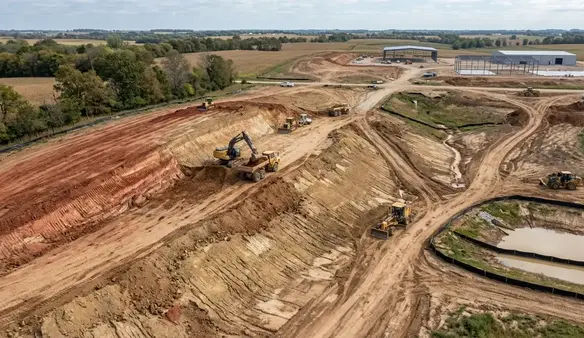
Local soil conditions, drainage patterns, and terrain characteristics all influence how a commercial site must be developed for long-term stability.
Not Sure What Conditions Exist Beneath Your Site?
Soil composition, drainage behavior, and elevation changes can dramatically affect excavation costs, grading requirements, and long-term site performance. A professional site review helps identify issues before construction begins.
Request A Site WalkWho We Work With
Commercial site preparation requires coordination between engineers, developers, contractors, inspectors, and property owners. Successful projects depend on every stakeholder working from the same grading, drainage, utility, and scheduling objectives.
These roles all depend on coordinated execution of grading and drainage systems, utility installation, and structural site preparation.
Commercial site preparation is never a one‑party operation. It’s a coordinated effort between the people who design the project, fund it, build it, and ultimately rely on it for decades. We partner with organizations across North Missouri who expect precision, communication, and accountability from their excavation contractor, not excuses.
Developers
Ground‑up commercial sites, industrial parks, retail centers, and mixed‑use projects where predictable grading, drainage, and pad performance directly impact financing milestones and construction timelines.
General Contractors
Schedule‑driven site preparation aligned with sequencing, inspections, and trade mobilization. We deliver pads, utilities, and access routes that allow the next contractor to start work immediately.
Civil Engineers
Field execution that matches engineered intent, grading plans, stormwater systems, utility corridors, and elevation tolerances built exactly as designed, with real‑time communication when conditions change.
Commercial Property Owners
Redevelopment, expansions, infrastructure upgrades, and new construction sitework that protects long‑term asset value and ensures stable performance for decades of use.
Municipalities
Public infrastructure, access roads, drainage improvements, and government facility sitework completed to municipal standards with transparent communication and compliance‑driven execution.
Industrial Operators
Heavy‑use facilities, logistics centers, equipment yards, and manufacturing expansions requiring structural pads, high‑load compaction, and long‑term durability under demanding operational conditions.
Commercial Site Preparation Service Area
We provide full-service commercial site preparation across North Missouri, supporting developers, general contractors, and property owners with mass grading, industrial excavation, parking lot construction, drainage systems, utility trenching, and build-ready site development. Every site is evaluated based on soil conditions, elevation changes, drainage flow, and engineered design requirements to ensure the property is ready for structural development and long-term performance.
From raw land development to full commercial pad preparation, we help turn undeveloped or underutilized properties into construction-ready sites that meet real engineering and compliance standards.
- Liberty, MO
- Smithville, MO
- Plattsburg, MO
- St. Joseph, MO
- Maryville, MO
- Chillicothe, MO
- Trenton, MO
- Hamilton, MO
- Gallatin, MO
- Cameron, MO
- Bethany, MO
- Princeton, MO
- Brookfield, MO
- Macon, MO
- Stanberry, MO
- King City, MO
- Albany, MO
- Jamesport, MO
- Lancaster, MO
- Unionville, MO
- Green City, MO
- Milan, MO
- Savannah, MO
- Rural North Missouri Commercial Corridors & Development Zones
If you’re developing commercial property anywhere in North Missouri, we can evaluate the site, analyze grading and drainage requirements, and determine the most efficient path to a build-ready foundation for your project.
What A Successful Commercial Site Prep Project Looks Like
Success isn't measured by how much dirt gets moved. Success is measured by what happens after excavation is complete.
Concrete crews arrive on schedule.
Utilities install without conflicts.
Inspectors find compliant grades.
Drainage performs as designed.
Parking lots remain stable.
Buildings stay supported.
The best commercial excavation projects are often the ones nobody talks about later because everything worked exactly as expected.
That is the objective on every project we perform: create a site so well prepared that the remaining phases of construction move forward with confidence.
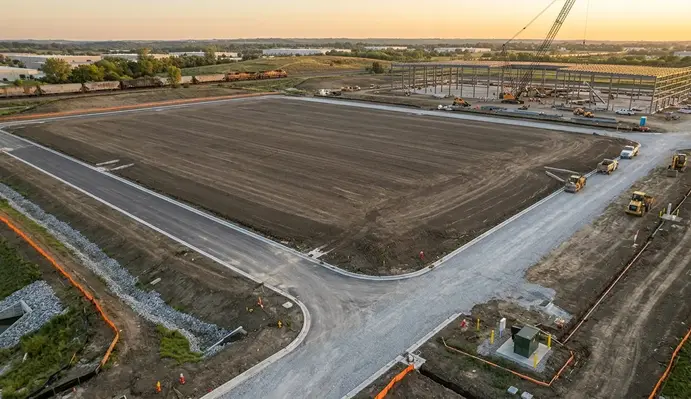
A successful site preparation project creates stable ground, proper drainage, accurate elevations, and a construction-ready site that allows the next phase to begin immediately.
Why Developers And Contractors Choose North Missouri Excavation
Commercial construction schedules leave little room for excavation mistakes. Our focus is delivering build-ready sites that support the next phase of construction without delays, rework, or costly surprises.
What sets our commercial site development apart:
Accurate grading based on engineered plans
Focus on cut and fill efficiency
Drainage planning designed for long-term performance
Utility coordination and sequencing
Commercial equipment capable of large-scale earthmoving
Clear communication throughout the project lifecycle
Experience working with developers and contractors
Commitment to schedule-driven site preparation
Our goal is simple: create a site that allows concrete crews, utility contractors, inspectors, and builders to begin work immediately after excavation is complete.
Commercial Site Preparation Frequently Included Services
Every commercial development has its own engineering requirements, but most projects rely on a core set of site preparation services to create stable, build‑ready conditions. Before vertical construction can begin, the ground must be shaped, drained, compacted, and serviced to support decades of commercial use.
Mass Grading
Balancing site elevations, optimizing cut‑and‑fill volumes, and establishing the foundation for drainage, utilities, and structural pads.
Land Clearing
Removing vegetation, debris, and unsuitable soils to expose stable ground and prepare the site for heavy equipment and grading operations.
Building Pad Construction
Creating engineered structural pads with controlled lifts, moisture conditioning, and compaction standards designed for long‑term load performance.
Utility Trenching
Excavation and trench preparation for water, sewer, electric, gas, and communication systems, coordinated to avoid conflicts and rework.
Stormwater Infrastructure
Installing drainage systems, swales, culverts, retention features, and runoff controls that meet regulatory requirements and protect the site long‑term.
Access Roads
Constructing temporary and permanent access routes, haul roads, and commercial entrances that support equipment movement and future traffic loads.
Why Commercial Developers Compare Excavation Contractors Carefully
Commercial site preparation is one of the first major construction investments on a development project. Because grading, drainage, utilities, and building pads affect every trade that follows, developers often evaluate contractors based on more than price alone.
Factors commonly considered include:
- Experience with commercial developments
- Earthmoving equipment capacity
- Ability to manage large grading operations
- Knowledge of drainage systems and site performance
- Utility coordination and trenching experience
- Project scheduling capabilities
- Communication with engineers and contractors
- Track record of delivering build-ready sites
The lowest bid is not always the lowest project cost. Efficient grading, accurate cut-and-fill calculations, and proper drainage planning can significantly reduce change orders and future corrective work.
Comparing Commercial Excavation Contractors?
We provide commercial site evaluations, grading analysis, drainage planning, utility coordination, and build-ready site preparation for projects across North Missouri.
Discuss Your ProjectFrequently Asked Questions About Commercial Site Preparation in North Missouri
Commercial site development is not just “moving dirt.” It involves engineered grading, drainage control, soil compaction standards, utility coordination, and ensuring the site is fully build-ready for structural loads, traffic demands, and long-term development. These are the most common questions we get from developers, general contractors, and property owners preparing land for commercial construction.
- What actually makes a commercial site “build-ready”?
- A build-ready site is one that meets engineering requirements for structural stability, proper drainage flow, and compaction standards before construction begins. That includes proper mass grading, removal of unsuitable soils, engineered subgrade preparation, and ensuring elevations match civil plans. If any of those steps are missed, it leads to settlement issues, drainage failures, and costly delays once construction starts.
- Why is commercial excavation more complex than residential dirt work?
- Commercial projects are built around engineered specs where drainage patterns must follow design plans, and utility work must align with installation requirements. That means tolerances matter, drainage patterns must follow design plans, and soil compaction often has to meet load-bearing requirements for buildings, parking lots, and heavy equipment traffic. There’s also coordination with utilities, engineers, and inspectors, so precision and sequencing matter far more than speed alone.
- How do you determine the right grading plan for a commercial site?
- We start with topography, soil conditions, and the civil engineering plan for the project. From there, we establish cut/fill balance, drainage flow paths, and final elevations that support structural pads, access roads, and stormwater systems The goal is to move earth efficiently while matching engineered specifications exactly, not just leveling the ground.
- What types of commercial projects do you typically prepare sites for?
- We handle warehouse developments, retail centers, industrial facilities, municipal infrastructure, parking lots, access roads, and large-scale commercial pads. Each project requires different compaction standards, drainage design, and access planning depending on traffic loads and building requirements.
- How important is drainage in commercial site preparation?
- It’s critical. Poor drainage design is one of the leading causes of long-term site failure. We shape sites to control stormwater runoff, prevent pooling around structures, and integrate properly with retention systems, culverts, and municipal drainage requirements. If water is not managed correctly from the start, it becomes an ongoing liability for the property owner.
- Can you build on flat land or undeveloped commercial lots?
- Yes, but flat land still requires engineered grading. Most sites need cut/fill balancing, drainage contouring, and structural pad elevation adjustments before construction can begin. We also evaluate soil stability and underground conditions to ensure the site can support long-term structural loads.
- What causes delays in commercial excavation projects?
- The most common delays come from unexpected soil conditions, weather impacts, utility conflicts, or changes in engineering plans during construction. Sites that are not properly evaluated early often require redesigns once grading begins. That’s why pre-construction planning and accurate site evaluation are critical.
- Do you handle utility trenching and infrastructure installation?
- Yes. We provide utility trenching for water, sewer, electrical, gas, and fiber infrastructure. Proper trench depth, bedding material, and alignment are critical to avoid future failures and ensure compliance with utility specifications and inspection standards.
- How do you ensure compaction meets commercial standards?
- We compact in engineered lifts using heavy equipment and moisture-controlled soil conditioning where required. Compaction is verified based on project specifications, especially for structural pads, parking lots, and load-bearing surfaces. This reduces settlement risk and ensures long-term stability for the finished structure.
- Can you fix or rework failed commercial site prep projects?
- Yes. We frequently correct issues such as improper grading, drainage failure, unstable subgrade, or settlement problems from incomplete site prep. The process depends on the severity of the issue, but often involves re-grading, soil stabilization, and drainage correction to bring the site back into compliance.
- How do I get an accurate estimate for commercial site preparation?
- Every commercial site is different, so accurate pricing requires a site evaluation. We review grading requirements, soil conditions, access for equipment, drainage design, and engineering plans before providing a detailed estimate. This ensures pricing reflects real project conditions, not rough assumptions.
Start Your Commercial Development With Proper Site Preparation
Build-ready excavation, grading, and infrastructure preparation for commercial and industrial projects across North Missouri.
Call (660) 371-5901