
Driveway & Rural Road Construction in North Missouri
Professional gravel driveway construction, rural road building, farm lane installation, culvert crossings, grading, compaction, and drainage correction for properties across North Missouri. We build stable, properly engineered access roads designed to handle heavy equipment, farm traffic, and Missouri’s clay soil, rain, and freeze-thaw conditions without rutting or washouts.
Serving Chillicothe, Kirksville, Cameron, Trenton, Bethany, Moberly, St. Joseph, Maryville, Brookfield, Macon, and surrounding North Missouri farms, acreage, and rural properties.
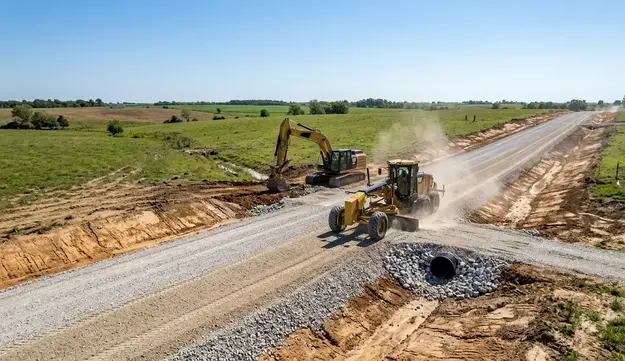
North Missouri Driveway Contractor for Gravel Roads and Rural Access Builds
If you want a driveway contractor in North Missouri who understands clay soil behavior, farm traffic loads, and how water moves across rolling terrain, you are in the right place. We build gravel driveways, private roads, and farm access lanes that hold up to real use, not just look good for a short time.
We engineer every project as a complete system. That means evaluating your soil, shaping drainage paths that actually work, stabilizing the subgrade, compacting the base rock, and finishing with a surface that sheds water instead of trapping it. Most driveway failures in this region come from skipping one of these steps, especially in clay heavy ground where moisture movement can destroy a poorly built road.
We have built rural access roads across farms, acreages, timber ground, and low lying bottomland throughout North Missouri. Our approach comes from real field experience. We understand how clay swells, how slopes drain, and how heavy equipment traffic affects a roadbed over time.
When you hire us, you are not getting a quick gravel drop. You are getting a contractor who treats your driveway like a long term investment, built to handle weather, traffic, and the soil conditions that make this region unique.
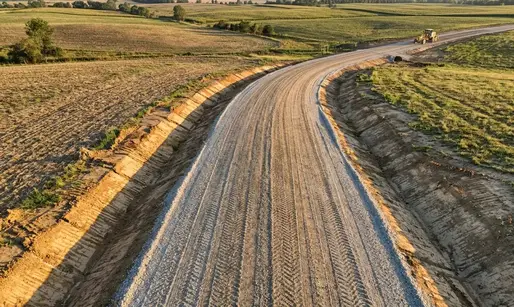
Professionally engineered gravel driveways are built as full drainage systems. Proper crown shaping and ditch grading ensure water sheds off the surface instead of cutting into the road during heavy Missouri rains.
Why Most Rural Driveways Fail in North Missouri
In North Missouri, driveway failure is almost never a gravel issue. It is a soil and water issue. Clay dominates this region, and clay does not behave like normal soil. It swells when it absorbs moisture, shrinks rock‑hard when it dries, and shifts under the weight of vehicles. If a driveway is not built to control that movement, it will fail no matter how much gravel you throw at it.
A driveway is only as strong as the structure beneath it. When the base is weak, the surface becomes a revolving door of potholes, ruts, mud, and washouts. Most of the driveways we rebuild were doomed the day they were installed because the soil was never stabilized and the water was never managed.
- Poor drainage creates washouts during heavy rain. When water runs down the driveway instead of off the driveway, it strips gravel, cuts channels, and exposes the base.
- Clay subgrade turns soft under moisture. Once clay becomes saturated, it loses all strength. Vehicles then pump that moisture upward until mud breaks through the surface.
- Improper slope traps water instead of shedding it. A driveway without a proper crown becomes a holding pond. Standing water is the fastest way to destroy a gravel road.
- Undersized culverts overflow or collapse. When a culvert cannot move water fast enough, the water finds a new path, usually straight across the driveway.
- Thin gravel layers disappear into the soil. Without a compacted base, gravel sinks into the clay below. Every new load becomes part of the mud instead of part of the road.
The truth is simple. A gravel driveway in North Missouri succeeds or fails based on how well it handles water and how well the subgrade is prepared. If those two things are wrong, nothing else will hold. If they are right, the driveway will last for decades.
Stop Fighting a Driveway That Keeps Failing
If your driveway is rutting, washing out, or turning soft after every rain, the issue is usually subgrade failure and drainage, not gravel. We diagnose and rebuild rural roads across North Missouri the correct way from the base up.
Get a Driveway Assessment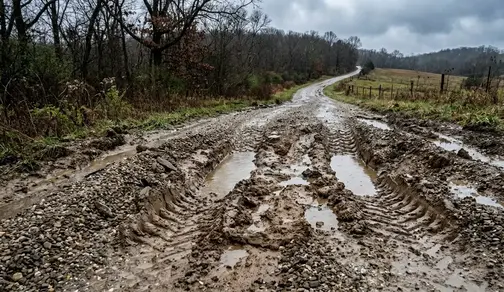
Most driveway failures in North Missouri come from water and clay interaction beneath the surface. Once the subgrade softens, even heavy gravel layers cannot prevent rutting and washouts.
Stop Spending Money on Gravel That Keeps Disappearing
If your driveway keeps rutting, washing out, or turning soft after every rain, adding more gravel won’t fix it. The problem is usually trapped water and an unstable clay subgrade underneath the surface.
We can identify the exact cause of failure and recommend a permanent fix, not temporary patchwork.
Get a Driveway Repair AssessmentWhat Separates a Road That Lasts 20 Years From One That Fails in 2?
Most people assume road construction is simple. Clear the path, spread some gravel, smooth it out, and you're done. Unfortunately, that's exactly why so many driveways and private roads across North Missouri become expensive maintenance problems.
The gravel itself is rarely the problem. The real difference between a road that lasts for decades and one that develops ruts, potholes, soft spots, and washouts comes down to what happens underneath the gravel long before the first load of rock ever arrives.
We often visit properties where thousands of dollars have already been spent on gravel over the years. The owner keeps adding more stone every season because the road keeps disappearing. What they're actually seeing is a structural failure underneath the surface.
When water becomes trapped in clay soil, every vehicle that drives across the road acts like a pump. Moisture rises upward, the clay loses strength, and the gravel slowly gets pushed down into the subgrade. More gravel gets added. The cycle repeats. The owner spends money every year but never solves the actual problem.
Water Is Always the First Thing We Look At
Experienced road builders don't start by asking what gravel you want. They start by asking where the water is going.
Every property has natural drainage patterns. Rainfall wants to move downhill. Surface water wants to collect in low spots. Groundwater follows the path of least resistance.
If those forces are ignored, the road is fighting nature every day. Eventually nature wins.
That's why we spend significant time studying slope, runoff direction, watershed flow, ditch elevations, low areas, culvert locations, and existing drainage problems before construction begins. A properly designed road works with the land instead of constantly battling against it.
The Subgrade Is More Important Than The Surface
Most road failures begin below ground level where property owners never see them.
North Missouri is dominated by expansive clay soils. These soils absorb moisture, swell, soften, dry out, shrink, and crack. Every season the ground is moving.
If the subgrade is not properly prepared, compacted, and stabilized, the driveway is essentially floating on unstable ground. No amount of top gravel can permanently fix that problem.
This is why professional road construction focuses heavily on excavation depth, moisture conditioning, proof rolling, compaction, and base preparation. The surface gravel may be the visible part of the project, but the subgrade determines whether the road survives long term.
Traffic Load Changes Everything
A driveway used by a family pickup truck and a driveway serving grain trucks during harvest are completely different engineering problems.
We regularly see roads that look adequate until harvest season arrives. Suddenly loaded grain trucks, fertilizer deliveries, livestock trailers, and heavy equipment begin using a structure that was never designed to handle those loads.
The result is predictable: wheel rutting, edge breakdown, shoulder collapse, culvert damage, and rapid deterioration of the base.
Building for anticipated traffic from the beginning is significantly less expensive than rebuilding a failed road later. That's why we ask detailed questions about equipment, truck traffic, livestock operations, future building plans, and how the property will actually be used over the next decade.
Good Road Construction Is Really Risk Management
Property owners often view a driveway as a simple convenience. In reality, it is critical infrastructure.
A failed road affects emergency access, delivery vehicles, construction projects, livestock operations, crop production, equipment movement, and even property value.
When a contractor properly addresses drainage, soil conditions, compaction, grade control, and traffic loads, they're not just building a driveway. They're reducing the likelihood of future repairs, downtime, erosion problems, access issues, and recurring maintenance expenses.
That's the mindset we bring to every project throughout North Missouri. We don't build roads to survive the next storm. We build them to keep performing after years of storms, heavy traffic, seasonal moisture changes, and the realities of rural property ownership.
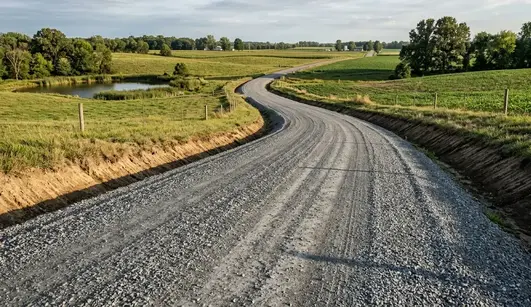
A long-lasting road starts with proper grade control, drainage planning, and a stable base. The gravel surface is only the visible portion of the engineering beneath it.
Build It Right Once Instead of Fixing It Every Year
The difference between a long-lasting rural road and a failing one always comes down to drainage control, subgrade preparation, and proper compaction, not surface gravel.
If you want a driveway that performs through heavy rain, freeze-thaw cycles, and farm traffic, we can design it correctly from the start.
Plan Your Driveway With UsThe Hidden Cost of a Poorly Built Driveway
A driveway that is built without proper base depth, drainage shaping, or soil evaluation does not just wear out early. It becomes a recurring expense that grows every season in North Missouri’s clay-heavy terrain.
- Repeated gravel hauling every season because the base never locked in and keeps pumping under moisture.
- Truck and trailer damage from deep rutting and soft spots that form after every rain event.
- Drainage erosion cutting into fields, yards, and ditches when the road crown and shoulders were never shaped correctly.
- Full rebuild costs when base failure spreads and the entire roadbed begins to break down under normal traffic.
In this region, most property owners end up paying two to three times more fixing a failed driveway than they would have spent building it correctly the first time. A proper base and drainage plan is always cheaper than years of patching.
North Missouri Terrain Challenges for Driveways & Roads
Clay Soil Movement
North Missouri clay swells when wet and shrinks hard when dry. Without a stabilized base, this constant movement creates ruts, soft spots, and surface failure that only get worse with traffic.
Low Lying Farm Ground
Bottom ground holds water longer than upland soil. Driveways in these areas require elevation building, ditching, and controlled runoff to prevent standing water and mud buildup.
Steep Rural Slopes
Hillsides in this region shed water fast. Without proper grading and a defined crown, runoff accelerates downhill and strips gravel off the surface in a single storm.
Heavy Equipment Traffic
Farm trucks, livestock trailers, and machinery put extreme pressure on the subgrade. These loads require a reinforced base, not a thin layer of gravel that shifts under weight.
Seasonal Freeze–Thaw Cycles
North Missouri winters push moisture up through the soil. Roads without proper compaction and drainage heave, crack, and break apart as temperatures swing.
Timber & Brush Areas
Wooded sections hide soft pockets, roots, and organic material that must be removed. Leaving organics in place guarantees future settling and uneven road surfaces.
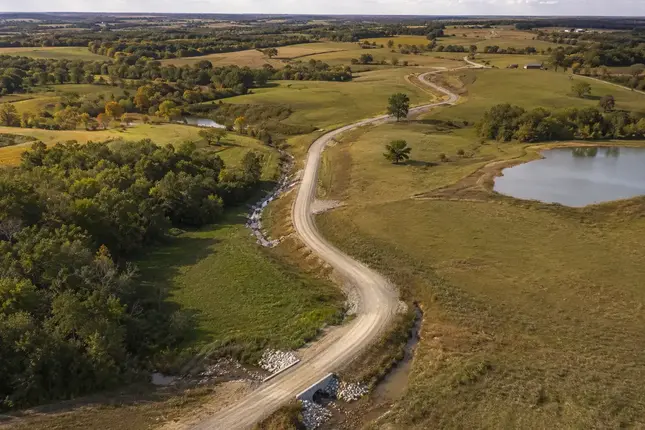
Every property presents unique challenges. Clay soil, rolling hills, timber ground, drainage patterns, and agricultural traffic all influence how a road must be designed and built.
Build a Road That Handles North Missouri Terrain
Clay soil, steep slopes, low ground, and heavy equipment traffic require proper grading, drainage control, and reinforced base construction. We design roads that perform in real rural conditions.
Talk About Your PropertyWho Our Driveway & Road Construction Is Built For
- Farm owners who need dependable access roads that hold up to tractors, feed trucks, and daily livestock movement.
- Acreage property owners building long private drives across rolling ground, creek bottoms, or wooded terrain.
- Homeowners tired of mud, ruts, washouts, and the constant battle with North Missouri clay after every rain.
- Builders who need reliable construction access roads that can support concrete trucks, deliveries, and job‑site traffic.
- Landowners improving rural or undeveloped property where proper grading and drainage make all the difference.
- Anyone who needs a road built to handle real‑world use, not just look good for a week before the first storm exposes weak spots.
Need Reliable Access for Your Property?
Whether it’s a farm, acreage, or new home site, we build driveways and rural roads designed for real-world use, not light traffic conditions.
If access matters on your property, we can design and build a road system that holds up long-term.
Call for Availability & PricingHow We Build Long-Lasting Driveways & Private Roads
- Site evaluation and natural drainage mapping We study how water naturally moves across your property. In North Missouri clay, drainage patterns decide whether a road stays solid or turns into a rut-filled mess after the first storm.
- Clearing and stripping organic material Topsoil, roots, and organics are removed so the road sits on firm ground instead of soft material that will pump, shift, and fail under traffic.
- Cut-and-fill grading for proper elevation We shape the roadbed with the correct crown and slope so water sheds off the surface instead of running down the middle and carving channels.
- Subgrade compaction for load stability Clay-heavy soils require moisture-balanced compaction. This step locks in density and prevents heavy trucks from sinking or creating soft spots.
- Culvert installation for water control Properly sized and placed culverts keep water moving where it should, protecting fields, ditches, and the roadbed from erosion.
- Base rock installation and compaction We install a true structural base, not just surface gravel. This is the load-bearing layer that keeps the road from breaking down over time.
- Final gravel surfacing and shaping The top layer is graded with a clean crown and tight shoulders so water sheds properly and the road stays smooth through every season.
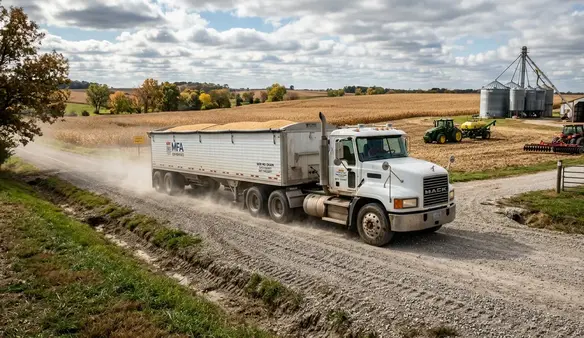
Rural roads must be engineered for agricultural loads including grain trucks, livestock trailers, and heavy equipment. These forces require stronger bases than standard residential driveways.
Roads Built For Real Missouri Farm Traffic
A driveway that handles pickup trucks is not automatically capable of supporting agricultural traffic. Across North Missouri we build roads designed for the equipment that actually uses the property.
- Combines and harvest equipment
- Livestock trailers and cattle operations
- Grain trucks and fertilizer deliveries
- Farm supply deliveries
- Construction traffic for barns and shops
Designing for these loads from the beginning reduces rutting, shoulder failures, culvert damage, and recurring maintenance costs later.
Equipment That Builds Roads That Actually Last
Driveway failure in North Missouri usually comes down to one thing, improper grading and base compaction. The equipment we use isn’t just about speed, it’s about controlling elevation, moisture, and density so the road structure holds up long-term.
- Dozers for structural grading & crown building Establishes proper slope so water sheds off the surface instead of sitting in the gravel. Essential for preventing rutting in clay-heavy soils.
- Excavators for drainage & culvert installation Used to correct natural water paths, install culverts, and reshape low areas where washouts typically start.
- Skid steers for final shaping & detail work Fine-tunes edges, shoulders, and transitions so water doesn’t funnel back onto the driving surface.
- Dump trucks for controlled base material placement Ensures gravel and base rock are placed in managed layers, not dumped unevenly where soft spots form later.
- Compaction equipment for load-bearing strength Locks the base in place so it can handle farm traffic, heavy trucks, and seasonal freeze-thaw movement without shifting.
- Moisture conditioning for proper clay compaction Clay in North Missouri won’t compact correctly unless moisture is balanced, too dry or too wet leads to long-term road failure.
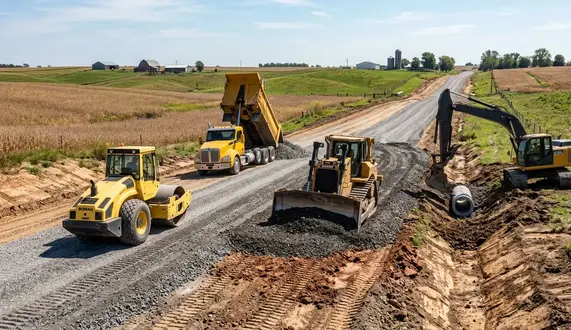
Long-lasting roads require far more than gravel. Proper grading, drainage correction, compaction, and base preparation all depend on specialized construction equipment working together as a complete system.
Choosing the Right Gravel for a North Missouri Driveway
Gravel selection is not just about picking a rock size. It is about matching the material to the soil beneath it, the traffic above it, and the water that wants to run through it. In North Missouri, where clay expands, contracts, and holds moisture like a sponge, the wrong gravel choice can turn a driveway into a rut-filled mess long before it should.
Start with the foundation, not the finish.
Many property owners focus on the top layer because that is what they see. But the surface stone is only as good as the structure underneath it.
A driveway built on soft clay without a proper base will swallow gravel, push mud upward, and lose shape no matter how often you top it off.
A durable driveway uses multiple layers, each with a job to do.
The bottom layer typically uses larger crushed rock such as 3 inch minus or 2 inch clean to create a rigid skeleton that resists movement.
Above that, a mid layer of smaller aggregate interlocks and tightens the structure.
The surface layer uses finer material that packs smooth while still allowing water to shed instead of pooling.
Drainage determines which gravel performs best.
On high ground with good runoff, a tighter surface mix works well.
In low lying areas or flat terrain, a more open rock blend may be needed to prevent water from sitting under the surface.
Clay soil does not drain on its own, so the gravel system must do the work.
Traffic type matters more than most people realize.
A driveway that sees grain trucks, livestock trailers, or construction equipment needs a deeper, stronger base than one used by passenger vehicles.
Heavy axles and tight turning forces can tear apart a driveway built with the wrong material or insufficient compaction.
Soil conditions dictate the design, not personal preference.
North Missouri clay behaves differently from sandy or loamy soils found elsewhere.
It holds water, swells when wet, and shrinks hard when dry.
The gravel system must be chosen to counteract movement, not just provide a smooth surface.
That is why we evaluate every property individually, including slope, soil density, drainage paths, and expected traffic. We recommend gravel blends that match the land’s behavior, not a generic mix that fails after the first wet season.
Not All Gravel Works for North Missouri Soil
The wrong gravel choice leads to rutting, sinking, and premature failure. We match material type and base design to your soil, drainage, and traffic conditions.
Call For Recommendations (660) 371-5901Building a New Home? Your Driveway Should Be Planned Early
One of the most costly mistakes we see during new home construction is treating the driveway as an afterthought. In North Missouri, the driveway is not just a path to the house. It is the lifeline that every contractor, supplier, and heavy truck depends on from day one.
Construction traffic destroys weak driveways fast. Concrete trucks, framing deliveries, septic crews, utility contractors, and material haulers all place extreme stress on an unfinished road. If the base is not built correctly from the start, the driveway often fails before the house is even under roof.
We build construction‑ready access roads that hold up to real abuse. Our approach is simple. We build the structural base first, designed to carry the heaviest loads your project will ever see. Once the home is complete, we transition that same road into a finished driveway that looks clean, drains correctly, and lasts for decades.
Drainage planning must happen before the first load of gravel arrives. New home sites often involve disturbed soil, elevation changes, and new runoff patterns. Without proper ditching, culverts, and crown design, water will undermine the driveway long before the landscaping is finished.
We design the driveway as part of the overall build, not an afterthought. That means evaluating soil conditions, slope direction, watershed flow, and long‑term traffic needs. A driveway built this way protects your investment, prevents costly repairs later, and ensures reliable access for every phase of construction.
When you bring us in early, you get a road that survives construction, supports the build, and becomes a permanent driveway you never have to worry about. This is why builders, landowners, and rural homeowners across North Missouri rely on us for high‑value, long‑lasting access solutions.
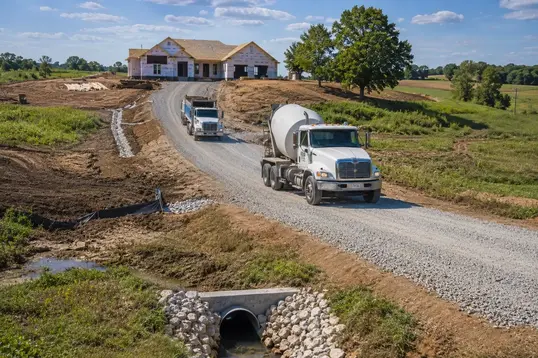
A properly built access road protects your project from day one, allowing heavy construction traffic to reach the site without destroying the driveway before the home is complete.
Types of Driveways & Roads We Build
Gravel Driveways
Residential and rural driveways built with proper base depth, compaction, and drainage shaping to handle North Missouri weather.
Farm Access Roads
Heavy‑duty routes designed for tractors, livestock trailers, and daily equipment traffic across working farm properties.
Private Rural Roads
Long access roads across acreage properties with engineered grading, crown control, and runoff management.
Construction Access Roads
Temporary or permanent access routes built to support concrete trucks, material deliveries, and job‑site equipment.
Hillside & Slope Roads
Roads built on rolling terrain with proper cut‑and‑fill balance and erosion control for long‑term stability.
Drainage‑Corrected Roads
Roads rebuilt or shaped to eliminate washouts, standing water, and soft spots caused by poor drainage.
Complete Driveway & Rural Road Construction Services
Gravel Driveway Installation
Full driveway builds starting from raw ground, including grading, moisture balanced compaction, structural base rock, and a properly crowned gravel surface designed to shed water and stay firm through Missouri’s wet seasons.
Rural Road Construction
Long private roads engineered for acreage properties and farm ground. Built to handle equipment traffic, clay soil movement, and seasonal freeze–thaw cycles without breaking down or washing out.
Driveway Rebuilding & Repair
We restore failed driveways by correcting the underlying issues, base failure, poor drainage, soft pockets, and improper grading, not just covering the problem with more gravel.
Culverts & Drainage Installation
Properly sized culverts, ditching, and water‑control systems that keep runoff moving where it should. Essential for preventing erosion, washouts, and long‑term roadbed damage.
Road Grading & Reshaping
We rebuild the road’s crown, eliminate low spots, and reshape shoulders so water sheds cleanly. This is the key to stopping rutting and extending the life of any gravel road.
Farm & Field Access Roads
Heavy‑duty access lanes built for tractors, feed trucks, livestock trailers, and daily agricultural use. Reinforced bases designed specifically for the weight and turning forces of farm equipment.
Culverts and Drainage Control for Rural Roads
In North Missouri, water is the single most destructive force working against any gravel driveway or rural access road. Clay soil holds moisture, slopes concentrate runoff, and seasonal storms push thousands of gallons of water across a property in a matter of minutes. If that water is not controlled, it will destroy even the best-built road.
This is why culverts and drainage systems are not “extras.” They are the backbone of a long-lasting driveway. Most of the failures we rebuild across the region trace back to undersized culverts, poor placement, or drainage paths that were never engineered to handle real storm flow.
- Correct Culvert Diameter Selection Culverts must be sized for watershed volume, slope, soil absorption, and storm intensity. Guessing leads to overflow, erosion, and complete road failure. We calculate the flow so the crossing handles real Missouri storms, not ideal conditions.
- Runoff and Stream Redirection Water always takes the easiest path. If that path is your driveway, it will cut channels, strip gravel, and undermine the base. We redirect water safely using culverts, swales, and controlled flow paths that protect the road instead of feeding erosion.
- Driveway Washout Prevention Washouts happen when water gains speed and volume. Proper culvert placement, ditch shaping, and crown design slow the water, move it off the road, and prevent the destructive force that tears driveways apart.
- Ditch Shaping and Stabilization Ditches are not just trenches. They are engineered channels that must carry water without collapsing or eroding. We build stabilized ditches that maintain shape, protect the shoulders, and keep water moving where it belongs.
- Elevation Building for Low Spots Many rural driveways sit lower than the surrounding ground. In these areas, water naturally collects and saturates the subgrade. We raise the roadbed, rebuild the base, and install culverts so the driveway stays above the water instead of sinking into it.
- Full Drainage System Design A culvert alone is not a drainage plan. We evaluate the entire watershed, slope direction, soil type, and traffic load to design a system that protects the road for decades. This is the difference between a driveway that survives storms and one that fails every spring.
When you hire us, you are not getting a quick fix. You are getting a contractor who understands how North Missouri water behaves, how clay soil reacts, and how to build a drainage system that keeps your driveway intact year after year. This is why our roads last and why property owners call us after every other “gravel guy” has failed.
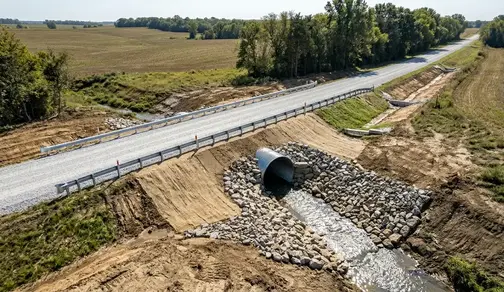
Properly sized culverts and engineered drainage systems prevent washouts, protect the road base, and keep stormwater flowing safely beneath the roadway.
Driveway Construction Challenges Across North Missouri Counties
North Missouri may look uniform on a map, but the ground tells a different story. Each county has its own blend of clay density, slope behavior, farm traffic, and drainage patterns, and those differences determine how a driveway or rural road must be built. Below is a breakdown based on real field experience across the region.
Daviess & Caldwell Counties
Around Gallatin, Hamilton, and the surrounding hills, water rarely travels in a straight line. The rolling terrain funnels runoff into narrow channels, and driveways built without proper crown or ditching quickly develop shoulder washouts. These counties demand careful slope shaping and erosion control, even a slight grading mistake can turn into a deep cut after one heavy rain.
Harrison & Mercer Counties
The clay-heavy soils near Bethany and Princeton expand when wet and tighten like concrete when dry. This constant movement destroys any driveway built without proper compaction. Long farm lanes here often require stabilization layers or geotextile reinforcement to prevent the base from “pumping” under equipment weight.
Nodaway & Worth Counties
These counties see some of the heaviest agricultural traffic in North Missouri. Grain trucks, silage wagons, and large machinery put enormous pressure on driveway bases and culvert crossings. Roads here must be built with thicker base rock and moisture-balanced compaction to survive harvest season without collapsing.
Livingston & Grundy Counties
Around Chillicothe and Trenton, low-lying farm ground and seasonal runoff create persistent drainage challenges. Driveways often need elevation building, ditch shaping, and properly sized culverts to stay above standing water. Without these steps, the clay subgrade saturates and the entire roadbed begins to sink.
Adair & Macon Counties
Much of the rural development in these counties runs through timber, brush, and undeveloped acreage. Clearing organics, removing root systems, and rebuilding the subgrade are essential, because leaving organic material under a driveway guarantees long-term settling and uneven surfaces.
Andrew, DeKalb & Clinton Counties
These counties are seeing rapid growth in residential acreage properties. New driveways must handle both construction traffic and long-term residential use, two very different load conditions. Proper base depth, compaction, and drainage planning are critical to prevent early failure once heavy equipment leaves and daily vehicle traffic begins.
Understanding these county-specific challenges is the difference between a driveway that lasts a season and one that lasts decades. North Missouri ground is unique, and your driveway should be built with that local knowledge in mind.
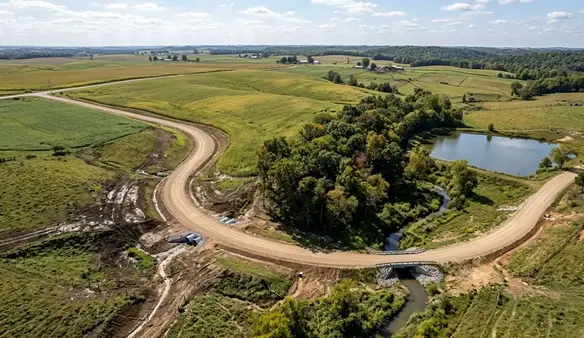
North Missouri roads encounter a wide range of terrain conditions including rolling hills, clay-heavy farmland, timbered acreage, drainage channels, and agricultural traffic corridors.
Driveway Conditions We Commonly See Across North Missouri
Every property is different, but North Missouri soil and terrain create predictable patterns. Understanding these local conditions allows us to design driveways and rural roads that hold up to weather, traffic, and the clay-heavy ground beneath them.
Near Gallatin and Jamesport
Rolling hills concentrate runoff into narrow channels. Without proper crowning and ditching, driveways here often suffer shoulder erosion, washouts, and gravel migration during heavy storms.
Near Bethany and Princeton
Dense clay soils expand when wet and tighten when dry. This movement creates pumping subgrades, soft pockets, and seasonal shifting that require deeper base layers and moisture-balanced compaction.
Near Chillicothe and Trenton
Low-lying ground and agricultural drainage patterns often overwhelm poorly designed driveways. Culverts, elevation building, and controlled runoff paths are essential to prevent standing water and roadbed saturation.
Near Maryville and Albany
Heavy farm traffic puts enormous stress on rural roads. Grain trucks, livestock trailers, and equipment require thicker structural bases and stronger compaction than typical residential driveways.
Near Macon and Kirksville
Timber ground and undeveloped acreage often hide organic layers, roots, and soft pockets beneath the surface. These areas must be excavated or stabilized to prevent long-term settling and uneven surfaces.
Near Cameron and Maysville
Residential acreage development is growing quickly in this region. New driveways must handle construction traffic first and long-term residential use second, which requires proper base depth and drainage planning from day one.
Because we work throughout North Missouri, we understand how local soil behavior, drainage patterns, and traffic demands shape long-term driveway performance. A design that works in one county may fail in another, which is why every project starts with understanding the land itself.
Driveway & Rural Road Construction Service Area
We provide professional driveway and rural road construction across North Missouri, building gravel driveways, farm lanes, private access roads, and long rural driveways designed to handle real-world traffic, heavy equipment, and Missouri weather conditions. Every road is built from the ground up with proper grading, compaction, and drainage so water sheds off the surface instead of destroying the base over time.
From residential gravel driveways to long farm access roads and culvert crossings on rural acreage, we build stable, properly structured surfaces that hold up through clay soil movement, freeze-thaw cycles, and heavy seasonal rainfall.
- Liberty, MO
- Smithville, MO
- Plattsburg, MO
- St. Joseph, MO
- Maryville, MO
- Chillicothe, MO
- Trenton, MO
- Hamilton, MO
- Gallatin, MO
- Cameron, MO
- Bethany, MO
- Princeton, MO
- Brookfield, MO
- Macon, MO
- Stanberry, MO
- King City, MO
- Albany, MO
- Jamesport, MO
- Lancaster, MO
- Unionville, MO
- Green City, MO
- Milan, MO
- Savannah, MO
- Rural North Missouri Driveways, Farms & Acreage Roads
If you’re building or upgrading a driveway, farm road, or rural access route anywhere in North Missouri, we can evaluate your property, check drainage flow and soil conditions, and build a properly engineered gravel road system designed to last.
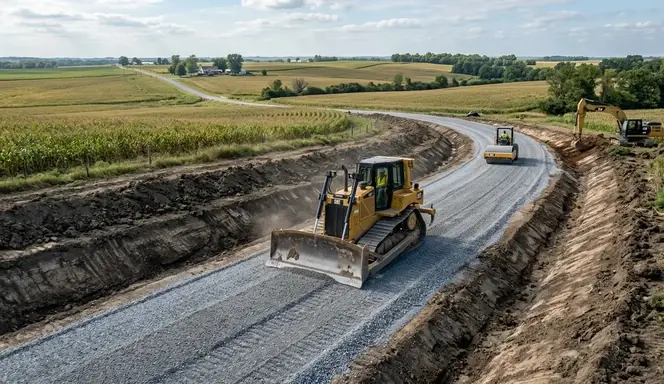
Every long-lasting driveway starts below the surface. Proper grading, crown development, ditch construction, and subgrade preparation create the foundation that prevents rutting, washouts, and premature failure.
Road & Driveway Construction Challenges Across North Missouri Counties
Road performance varies dramatically across North Missouri because soil composition, terrain, drainage patterns, and agricultural traffic loads differ from county to county. Experience working across the region helps identify the challenges that commonly affect long-term driveway durability.
Daviess County
Rolling terrain around Gallatin frequently creates runoff concentration issues. Proper ditching and crown design are critical to preventing washouts on long rural driveways.
Harrison County
Clay-heavy ground around Bethany often requires additional stabilization and thicker aggregate bases to prevent seasonal rutting and settlement.
Gentry County
Farm traffic places significant demands on access roads. Grain trucks and equipment require stronger road structures than typical residential driveways.
Nodaway County
Large agricultural operations and rolling ground make drainage planning one of the most important parts of road construction.
Mercer County
Low-lying areas can create persistent moisture problems that require elevation building and careful water management.
Grundy County
Driveways serving acreage homes often need to accommodate both construction traffic and long-term residential use without premature failure.
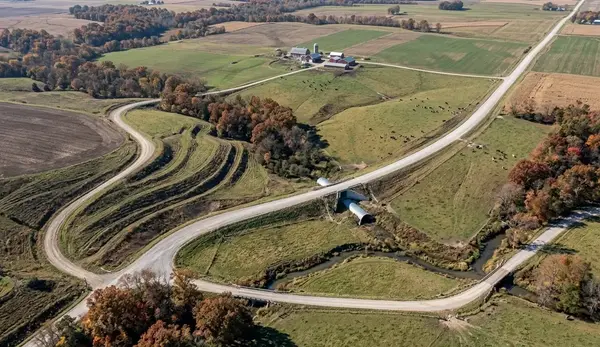
Road performance varies across North Missouri due to changing terrain, drainage patterns, watershed size, and soil composition. Understanding local conditions is critical when designing roads that can withstand decades of use.
Who We Build Driveways and Rural Roads For
Every property has its own demands. Soil conditions, traffic loads, and drainage patterns vary across North Missouri, so we design each road around how it will actually be used. These are the clients who rely on us when they need a driveway or access road built right the first time.
Homeowners
Residential driveways, acreage entrances, and long rural approaches built for dependable year‑round access. Designed to handle daily traffic, delivery vehicles, and North Missouri’s clay‑heavy soil conditions.
Farm and Ranch Operations
Heavy‑duty farm roads engineered for tractors, grain trucks, livestock trailers, and equipment that puts real stress on a roadbed. Built with reinforced bases and drainage systems that stand up to seasonal field conditions.
Developers
Construction entrances, subdivision access roads, and infrastructure routes that support new residential, agricultural, and commercial development. Built to withstand heavy construction traffic from day one.
Hunting and Timber Properties
Remote access lanes, timber roads, creek crossings, and seasonal routes built through rugged ground. Designed to stay passable during wet seasons and withstand repeated off‑road use.
Commercial Properties
Gravel lots, equipment yards, service roads, and high‑traffic surfaces built for durability and load‑bearing performance. Ideal for businesses that rely on reliable access for trucks and machinery.
Landowners and Acreage Owners
Long private driveways, estate entrances, farm lanes, and multi‑use access roads tailored to rural property needs. Built to handle mixed traffic, varied terrain, and long‑term use without constant maintenance.
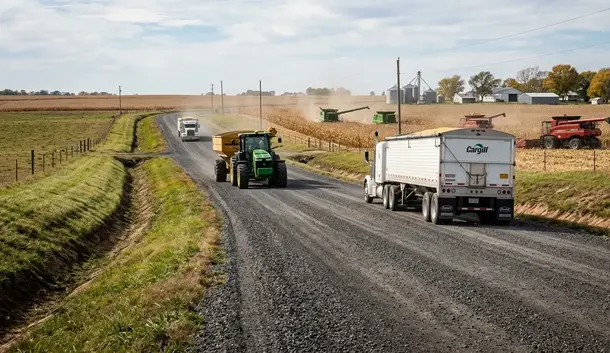
Farm roads face much greater stress than typical residential driveways. Grain trucks, livestock trailers, tractors, and heavy equipment require stronger road structures, thicker aggregate bases, and proper drainage systems.
What Driveway and Rural Road Construction Typically Costs in North Missouri
Pricing in North Missouri is driven by what lies beneath the surface. Clay density, moisture retention, slope, and drainage behavior determine how much excavation, stabilization, and base rebuilding is required before gravel can even be placed.
Two driveways may look identical from the road, yet have completely different costs once we evaluate subgrade stability, water flow, and the structural build‑up needed to support long‑term traffic.
Gravel Driveways
$3,000 – $18,000+
Lower ranges apply to short residential drives with stable soil and natural drainage. Higher ranges involve correcting slope, repairing soft spots, or rebuilding the base to prevent gravel loss and rutting.
Farm and Field Roads
$5,000 – $40,000+
Built for tractors, grain trucks, and seasonal heavy loads. Costs increase when clay stabilization, ditching, culvert installation, or elevation building is required to handle real farm traffic.
Long Private Access Roads
$10,000 – $100,000+
Length, terrain changes, watershed size, and drainage crossings are the primary cost drivers. These are engineered road systems designed for long‑term reliability, not simple gravel spreads.
What Determines Your Exact Price
- How much water is moving through or under your driveway
- Whether we can build on existing soil or must rebuild the base
- Slope, elevation changes, and runoff direction
- Expected traffic load (cars vs. farm equipment vs. trucks)
Most “cheap” driveways fail because these factors were ignored up front. We evaluate them before pricing so your estimate reflects the real build, not a guess.
Lower‑cost projects typically involve firm ground with predictable drainage. Higher‑cost builds usually require drainage corrections and grading improvements, rebuilding weak subgrade, or addressing the instability of North Missouri clay.
We do not estimate blindly over the phone. Every project is priced after an on‑site evaluation of soil conditions, slope, drainage patterns, and equipment access so you receive an accurate, realistic cost for your specific property.
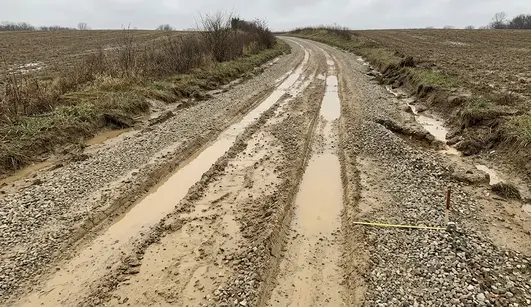
Most driveway failures begin beneath the gravel. Water trapped in clay soil weakens the subgrade, creating rutting, soft spots, gravel loss, and structural instability that worsens with every season.
Get an Exact Price for Your Driveway or Road
Every project is different. We evaluate slope, drainage, soil conditions, and access before giving a real estimate based on your property, not guesswork.
Call for a Site Visit & EstimateWhy Missouri Clay Causes So Many Driveway Failures
Across North Missouri, driveway failure is often blamed on gravel when the real culprit is the clay beneath it. Counties like Daviess, Harrison, Gentry, Mercer, Grundy, Livingston, Caldwell, and Clinton sit on dense, moisture‑reactive clay that behaves nothing like sand or loam. If a driveway is not engineered specifically for this soil type, failure is only a matter of time.
Clay expands when wet, contracts when dry, and shifts under load. That constant movement destroys weak roadbeds, especially those built without proper drainage, compaction, or subgrade preparation.
Clay Holds Water and Refuses to Drain
Missouri clay acts like a sponge with no outlet. Once it absorbs water, it holds it for days or weeks. Even when the surface looks dry, the subgrade beneath the driveway can still be saturated and unstable.
Constant Expansion and Shrinkage
Wet clay swells upward and pushes against the road structure. Dry clay shrinks and leaves voids beneath the base. This cycle repeats every season, creating dips, cracks, settlement, and long‑term structural distortion.
Heavy Loads Crush Weak Clay Quickly
Grain trucks, livestock trailers, tractors, and delivery vehicles apply tremendous pressure. When clay is wet, it loses nearly all load‑bearing strength, causing rutting, pumping, and rapid base failure.
Freeze–Thaw Cycles Break the Structure Apart
Water trapped in clay expands when frozen and contracts when thawed. This movement fractures weak roadbeds, lifts gravel, and exposes underlying deficiencies in drainage and compaction.
Clay Creates Hidden Soft Spots
Buried pockets of clay hold moisture long after surrounding soil dries. These isolated weak zones cause localized sinking, wheel‑track deformation, and recurring soft spots that grading alone cannot fix.
Clay Magnifies Every Drainage Mistake
On clay, even minor drainage issues become major failures. A missing crown, undersized culvert, or poorly shaped ditch allows water to sit, and standing water is the fastest way to destroy a gravel driveway in this region.
Common Warning Signs of Clay‑Related Driveway Failure
- Standing water that lingers long after rain stops
- Deep ruts forming in the same wheel tracks every season
- Gravel slowly disappearing into the subgrade
- Soft spots that return no matter how often the road is graded
- Uneven settlement and low areas developing over time
- Washouts occurring even after adding new gravel
How We Build Roads That Survive Missouri Clay
We engineer driveways from the ground up. That means evaluating soil density, moisture content, slope direction, watershed flow, and traffic load before any gravel is placed. Depending on conditions, we may undercut weak material, rebuild the subgrade, install drainage systems, raise the roadbed, or compact the base in controlled lifts.
The goal is simple: create a stable, well‑drained foundation that can withstand wet springs, dry summers, freeze–thaw winters, and the heavy traffic common on rural North Missouri properties.
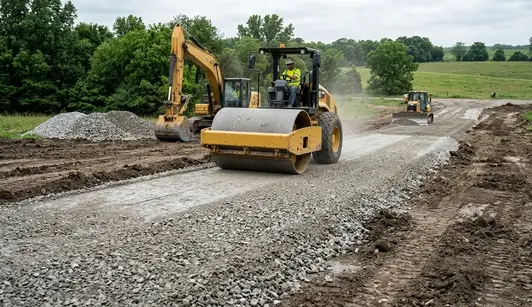
Proper compaction is one of the most important steps in road construction. A dense, stable base distributes vehicle loads evenly and prevents settlement, pumping, and premature surface failure.
Why Property Owners Call Us for Driveways & Rural Roads
Most driveway failures in North Missouri aren’t caused by “bad gravel.” They come from contractors who ignore how clay soil behaves, skip proper base prep, or grade without understanding natural water flow. Our work is built around the land itself, not shortcuts.
- Built for Missouri clay soil behavior We engineer every road around clay expansion, contraction, and moisture cycles so it stays firm through wet springs, dry summers, and freeze–thaw winters.
- Drainage-first construction approach Water is the #1 reason rural roads fail. We shape every driveway to shed water immediately, protecting the base and preventing rutting, washouts, and soft spots.
- Heavy equipment experience on rural ground Farm lanes and acreage roads take real abuse. We build for tractors, trailers, feed trucks, and daily traffic, not just light residential use.
- Proper subgrade prep and compaction We stabilize the subgrade and compact the base rock to true density. This is what keeps the road from pumping, sinking, or shifting under load.
- Clear, honest site evaluations We walk your property, explain what’s happening with your soil and drainage, and give you a straightforward plan, no guesswork, no inflated bids.
- Local expertise built on real North Missouri conditions Our work is shaped by years of experience with clay-heavy soils, rolling terrain, and rural access needs across the region.
We’re excavation professionals who build roads the right way, engineered for North Missouri ground, weather, and real-world use.
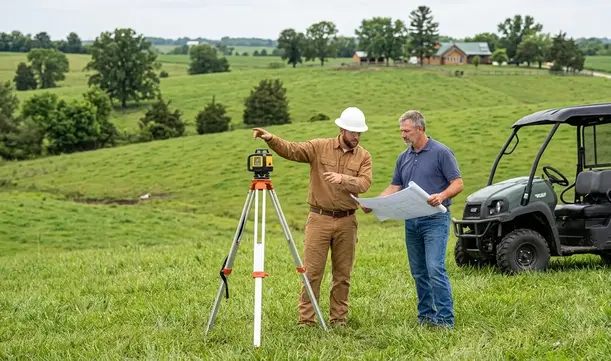
Every project begins with evaluating drainage flow, slope conditions, soil stability, and traffic requirements. Understanding the site allows us to design a road system that performs for years rather than seasons.
What Happens When You Call Us
- We evaluate your property, slope, and drainage flow Every project starts with understanding how your land naturally moves water. In North Missouri clay, drainage dictates whether a driveway lasts or fails.
- We identify weak soil and problem areas Soft pockets, organics, and low spots are flagged early so they can be corrected before they turn into ruts or sink points.
- We design proper grade and water movement We map out crown, slope, and runoff paths so water sheds off the road instead of running down it and washing your gravel away.
- We build the subgrade and compact the base This is where the real structure comes from. A properly compacted base locks the road in place and prevents future settling.
- We install culverts and drainage corrections if needed When water has nowhere to go, it destroys roads. We install culverts, ditches, and relief points to keep runoff controlled.
- We finish with a stable gravel surface built for traffic The final layer is shaped with a clean crown and tight shoulders so it stays firm under trucks, trailers, and daily use.
You’re not getting a quick gravel dump. You’re getting a properly engineered road system built to handle North Missouri weather, clay soil movement, and real‑world traffic.
Stop Fighting Mud, Ruts, and Washouts on Your Driveway
If your driveway is holding water, washing out, or breaking apart every season, the issue isn’t gravel, it’s how the road was built underneath. We can evaluate your property and tell you exactly what’s causing the failure and how to fix it permanently.
Most projects can be corrected with proper grading, drainage control, and base reconstruction, without constant maintenance or repeated gravel hauling.
Get a Driveway Evaluation Today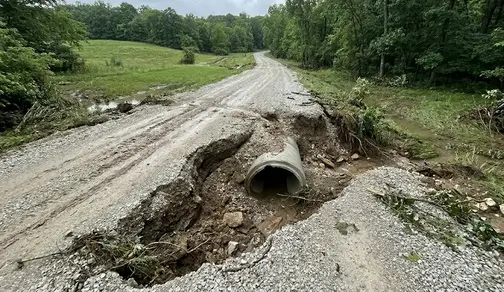
Small drainage issues often become major structural failures. Once runoff begins cutting channels through a driveway, erosion accelerates and repair costs increase significantly.
What Happens When Driveway Problems Are Ignored?
Driveway issues rarely explode overnight, they creep in slowly. A little standing water here, a rut that gets a bit deeper each month, a culvert that doesn’t drain quite like it used to. In North Missouri’s clay-heavy soil, those “small” problems don’t stay small for long. Once water and traffic start working against a weak spot, the damage accelerates quickly.
-
Small drainage issues become major washouts.
When water finds a low spot, it keeps returning to it. Over time, that trickle becomes a channel, and that channel becomes a full washout that can take out shoulders, gravel, and even culverts. Many of these failures can be prevented with proper grading and drainage improvements. -
Heavy vehicle traffic deepens ruts and soft spots.
Once the base starts to weaken, every truck, trailer, or tractor compounds the damage. Clay soil “pumps” under weight, pushing water and mud upward until the road loses its structure entirely. -
Gravel loss accelerates after every storm.
Without proper crown and drainage, gravel migrates downhill or washes into ditches. What starts as a thin spot becomes a bare patch, and bare patches turn into potholes and exposed subgrade. -
Repair costs increase as road base failure spreads.
A simple grading fix can turn into a full rebuild if the base layer becomes saturated or contaminated with organics. In severe cases, sections of the road may require full excavation and site preparation before reconstruction can begin. The longer the issue sits, the more of the roadbed has to be replaced. -
Culverts clog and redirect water where it shouldn’t go.
A partially plugged culvert doesn’t just slow drainage, it forces water to cut new paths across your driveway or yard, creating erosion that can undermine the entire structure. -
Seasonal freeze–thaw cycles magnify every weakness.
In winter, trapped moisture expands and lifts the road. In spring, it thaws and collapses. Small imperfections become deep dips, soft pockets, and long-term structural failures.
Addressing these issues early is almost always the most cost‑effective route. A bit of reshaping, drainage correction, or base reinforcement now can save you from a full rebuild later, especially in clay soil that doesn’t forgive neglect.
How Long Should a Properly Built Gravel Driveway Last?
A well‑built gravel driveway isn’t something you should be fighting with every spring. When the structure underneath is done right, a gravel drive becomes one of the most reliable, low‑maintenance surfaces you can have on rural Missouri ground.
A properly stabilized subgrade is the foundation of longevity. North Missouri clay expands when wet and tightens like concrete when dry. If the subgrade isn’t compacted at the right moisture level, the entire driveway will flex with the seasons, leading to ruts, dips, and soft pockets. A stable subgrade prevents that movement and keeps the roadbed locked in place.
Drainage control is what determines whether a driveway lasts decades or just a few seasons. Water is the enemy of gravel roads. If it sits on the surface, it washes gravel away. If it gets under the base, it destroys the structure from below. A driveway with proper crown, ditches, and culverts can handle Missouri’s heavy rains without losing shape.
A compacted base rock layer is what carries the load. When the base is installed in lifts and compacted correctly, it forms a dense, interlocked structure that supports trucks, trailers, and farm equipment. This is the difference between a driveway that stays firm and one that pumps mud through the gravel after every storm.
With all of these elements in place, a gravel driveway can last 20–30 years with only routine maintenance, light grading, occasional touch‑ups, and periodic surface stone replacement. The gravel itself isn’t what determines lifespan; the engineering underneath is.
That’s why every driveway we build starts with grading, drainage planning, crown design, runoff control, and base stabilization before a single load of gravel is delivered. When the structure is right, the surface takes care of itself.
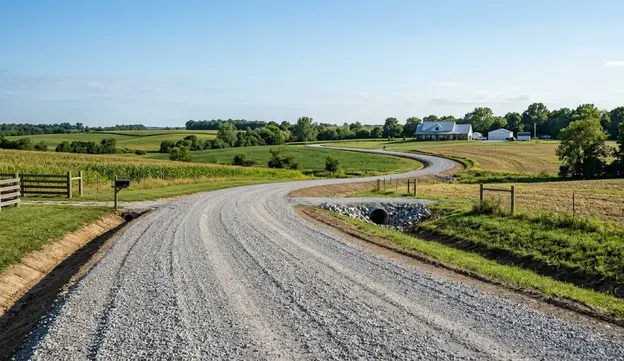
Properly built rural driveways combine grading, drainage management, compaction, and aggregate placement into a complete road system engineered for long-term performance.
Typical Driveway & Road Projects We Build Across North Missouri
North Missouri isn’t a “one‑type‑fits‑all” region. The terrain shifts from rolling uplands to tight clay flats, and the traffic ranges from daily commuters to fully loaded grain trucks. The projects we build reflect that variety, each one engineered for the soil, slope, and real‑world use it will face.
-
Long farm access roads serving row crop and livestock operations
These roads take a beating from grain trucks during harvest, feed deliveries in winter, and tractors throughout the year. We build them with reinforced bases, proper ditching, and moisture balanced compaction so they stay firm even when the fields are saturated. -
New residential gravel driveways for homes built on acreage
Acreage homes often sit on uneven or freshly disturbed ground. We shape the subgrade, establish a stable base, and design the crown so the driveway sheds water instead of funneling it toward the house or garage. -
Access roads through timber properties and hunting land
Timber ground hides soft pockets, roots, and organic layers that must be removed or stabilized. We clear, grade, and rebuild the roadbed so it stays solid through wet seasons and doesn’t sink as organics break down. -
Heavy‑duty driveways designed for grain trucks and equipment trailers
These aren’t “normal” driveways, they’re engineered load paths. We use thicker base rock, tighter compaction, and proper shoulder support to handle turning forces and axle loads that would destroy a standard gravel drive. -
Culvert crossings over drainage channels, creeks, and waterways
North Missouri’s drainage patterns can change dramatically after a single storm. We size culverts correctly, set them at the right grade, and build stable approaches so they don’t plug, wash out, or undermine the road. -
Construction access roads for new homes, shops, barns, and commercial sites
Before a structure goes up, the site needs a road that can handle concrete trucks, delivery semis, and repeated heavy traffic. We build temporary or permanent access roads that won’t collapse under construction loads or turn into a mud pit after the first rain. These projects are frequently completed alongside building pad preparation and commercial site development.
Every project we build is tailored to the land it sits on, clay density, slope, drainage, and expected traffic. That’s why our roads hold up where others fail: they’re engineered for North Missouri, not copied from a generic template.
Common Driveway & Rural Road Problems We Fix Across North Missouri
Most driveway failures begin long before the first pothole shows up. In North Missouri’s clay-heavy ground, water, soil movement, and traffic slowly break down a road from the inside out. By the time the surface shows damage, the real problem is already deeper in the structure.
Below are the issues we see most often across the region, explained in a way that helps you understand what’s really happening beneath your tires.
Muddy Driveways That Never Dry Out
When a driveway stays muddy long after the yard dries, moisture is trapped inside the roadbed. North Missouri clay acts like a bowl, holding water under the gravel. Every vehicle pumps that moisture upward until mud breaks through the surface. Many of these issues originate from inadequate drainage and can often be corrected through targeted grading and drainage improvements.
Washouts After Heavy Rain
If the crown is gone or never built correctly, stormwater runs straight down the wheel tracks. Once water gains speed, it strips gravel, cuts channels, and exposes the base. A washout is usually a symptom of a deeper drainage design failure.
Gravel Disappearing Into the Ground
When the subgrade loses strength, gravel sinks into the clay instead of staying on top. Adding more rock only feeds the problem. The base must be rebuilt or stabilized before any surface material will last.
Hillside Driveways Losing Gravel
On slopes, gravity and runoff work together. Without proper shaping, every storm pulls gravel downhill. Over time, the surface thins, larger stone appears, and erosion gullies form. Hills require precise slope transitions and shoulder control.
Culverts That Plug or Overflow
Undersized or poorly set culverts back up during storms, forcing water over the driveway. This erodes shoulders, weakens the base, and can destroy entire sections in a single event. Correct sizing requires understanding watershed flow, not guesswork.
Farm Roads Breaking Down Under Equipment
Roads that handle pickups just fine often fail instantly under grain trucks, feed deliveries, or tractors. Heavy axles and tight turns expose weak bases quickly. Farm roads need deeper structure and stronger compaction than residential drives.
Soft Spots After Every Rain
Soft spots usually mean something is buried beneath the surface: old topsoil, roots, organics, or clay pockets that hold moisture. These areas rarely improve with grading alone and often require excavation and subgrade reconstruction before the roadway can be stabilized.
New Construction Driveways Failing Early
Many new driveways are built quickly during construction, not correctly. Heavy concrete trucks and delivery vehicles crush the base before it has time to stabilize. Once the home is finished, the driveway begins settling, rutting, and draining poorly. Proper site preparation and building pad construction during the early phases of development can help reduce these problems.
The Pattern We See Across North Missouri
Whether we’re working near Gallatin, Bethany, Chillicothe, Trenton, Cameron, Princeton, Albany, or Maryville, the root causes are almost always the same.
- Poor drainage design
- Weak or unstable subgrade
- Improper grading or crown
- Road not built for actual traffic loads
Anyone can spread more gravel. The real solution comes from understanding the soil, the water, and the structure beneath the surface. Long-term results often require a combination of drainage corrections, excavation work, and proper roadway construction techniques. That’s where long-term fixes begin.
We Can Diagnose What’s Really Breaking Your Driveway Down
Mud, washouts, soft spots, and gravel loss are almost always symptoms of deeper drainage and soil issues. We fix the root cause, not just the surface damage.
If your driveway is failing, we can evaluate it and tell you exactly what it will take to fix it permanently.
Get a Fast Site Evaluation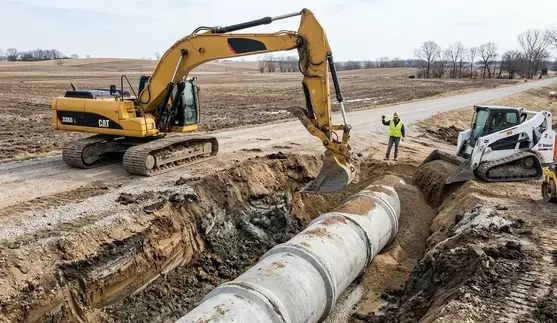
Proper culvert installation allows water to move beneath the road instead of across it. Correct sizing, placement, and elevation are critical to preventing washouts and erosion.
Recent North Missouri Driveway and Rural Road Projects
Our work spans the full range of North Missouri terrain, from rolling uplands to low‑lying bottom ground. Each project below reflects the real conditions we deal with daily: clay that holds water, slopes that concentrate runoff, and farm traffic that punishes weak roadbeds. These are not generic gravel jobs. They are engineered solutions built for long‑term performance.
Gallatin and Jamesport: We rebuilt multiple gravel driveways where runoff from surrounding hills had carved deep channels through the surface. The solution required ditch reshaping, crown correction, and new culvert installations to redirect stormwater away from the roadbed as part of a larger drainage improvement project.
Bethany and Princeton: Farm access roads serving grain trucks and livestock operations were reconstructed with thicker structural bases and moisture‑balanced compaction to eliminate pumping clay and seasonal soft spots.
Chillicothe and Trenton: Several rural driveways in low‑lying areas required elevation building, culvert replacement, and full drainage redesign to prevent standing water and subgrade saturation.
Albany and Maryville: We upgraded long farm lanes exposed to heavy equipment traffic, reinforcing the base and stabilizing shoulders to prevent gravel migration on sloped terrain.
Daviess, Harrison, Gentry, and Grundy Counties: Acreage access roads were constructed through timber, pasture, and mixed soil conditions. These projects required land clearing, rebuilding the subgrade, and installing drainage systems capable of handling unpredictable watershed flow.
Every site presents its own challenges. Soil density, slope direction, watershed size, and traffic demands vary widely across North Missouri. That is why we design each driveway and rural road from the ground up instead of relying on a standard template. The result is a road that holds its shape, drains correctly, and stands up to real use year after year.
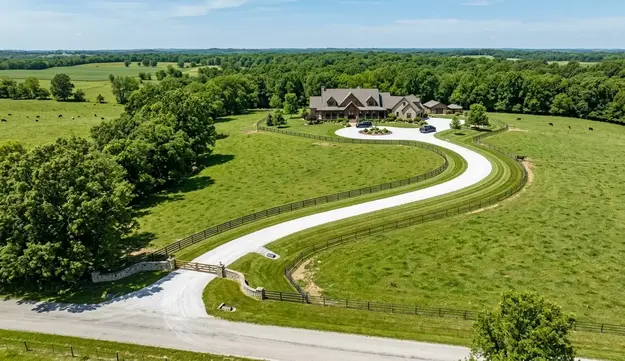
A properly engineered driveway should provide reliable access year-round while requiring minimal maintenance. Stable subgrades, proper drainage, and quality construction create roads that last for decades.
Frequently Asked Questions About Driveway & Road Construction in North Missouri
A properly built driveway or rural road is more than just gravel on the ground, it’s a structured system of grading, compaction, drainage control, and base preparation. In North Missouri, where clay soil, heavy rain, and freeze-thaw cycles are constant challenges, poor road construction quickly leads to rutting, washouts, and costly repairs. These are the most common questions we get from property owners building or upgrading driveways, farm lanes, and rural access roads.
- What makes a properly built driveway or rural road?
- A properly built driveway starts with a shaped and compacted subgrade, followed by a stabilized base layer and correctly graded gravel surface. The key is not just adding rock, it’s building structure, elevation control, and drainage so water sheds off instead of sitting in the surface.
- Why do gravel driveways fail in North Missouri?
- Most driveway failures come from poor base preparation, not the gravel itself. Common issues include building on soft clay, skipping compaction, flat grading with no runoff control, and undersized or missing culverts. Once water gets into the base layer, the road begins to rut and break apart.
- What does professional driveway construction include?
- It includes clearing and shaping the path, cutting high spots, filling low areas, compacting the subgrade, installing base material, adding gravel layers, and finishing grade for proper water runoff. Culverts are installed where needed to safely move water across driveways and road crossings.
- Why is compaction so important for driveways and roads?
- Compaction locks the soil and base material together, preventing shifting under vehicle traffic. Without proper compaction, gravel spreads out, tires cut into soft areas, and water quickly breaks down the road structure — especially during Missouri rain and freeze cycles.
- How do you prevent driveway washouts and erosion?
- We design the road with proper slope so water flows off the surface instead of traveling down it. This includes crowned driveways, ditching where needed, installing culverts, and stabilizing high-flow runoff areas to prevent erosion damage.
- Do I need a culvert for my driveway?
- If your driveway crosses a ditch, drainage path, or natural water flow area, a culvert is usually required. Undersized or missing culverts are one of the biggest causes of driveway washouts during heavy rain events in North Missouri.
- What type of gravel is best for driveways and farm roads?
- The best driveways use a layered system, a compacted base of larger crushed rock topped with finer gravel for stability and smooth driving. This combination locks together under pressure and resists shifting better than uniform gravel alone.
- Can you build long rural access roads across fields or acreage?
- Yes. We regularly build long farm lanes and rural access roads across pasture, timber, and undeveloped acreage. These projects often require grading through uneven terrain, managing drainage, and stabilizing soft agricultural ground.
- How long does a driveway or road installation take?
- Small residential driveways can often be completed in 1–2 days. Longer rural roads or projects requiring heavy grading, culverts, or soil correction may take several days depending on conditions and weather.
- Why does my driveway get muddy after rain?
- Mud problems usually come from a weak base layer or no proper drainage system. When water sits under or on top of the driveway, it saturates the clay subgrade and turns the surface soft, leading to rutting and sinking.
- How do I get an accurate estimate for driveway or road construction?
- The most accurate estimate comes from an on-site evaluation where we check soil conditions, slope, drainage paths, driveway length, and equipment access. Every property behaves differently, especially in North Missouri clay and rolling terrain.
Build a Driveway That Holds Up in North Missouri Conditions
We design and construct gravel driveways and private roads with proper grading, drainage control, base preparation, and compaction to prevent rutting, washouts, and seasonal failure.
Call Now (660) 371-5901