
Pond Construction & Excavation in North Missouri
Professional pond construction, pond excavation, pond rebuilding, watershed shaping, clay sealing, drainage control, and rural land excavation services across North Missouri. We build farm ponds, livestock ponds, fishing ponds, and recreational ponds designed to hold water long-term in real Missouri soil conditions.
Serving Chillicothe, Kirksville, Cameron, Trenton, Bethany, Moberly, St. Joseph, Maryville, Brookfield, Macon, and surrounding North Missouri farms and acreage properties.
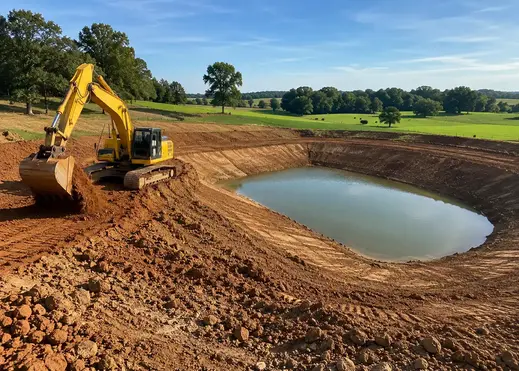
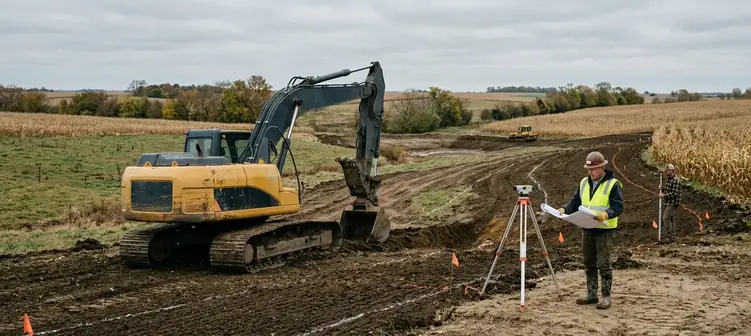
Every pond starts with understanding watershed flow, elevation, and how water naturally moves across the land.
Most Expensive Land Mistakes Happen Before the First Shovel Hits the Ground
The most expensive excavation projects rarely fail because of the equipment. They fail because important site conditions weren't identified before construction began. Once excavation starts, correcting drainage issues, unstable soils, poor access, or grading mistakes often requires additional labor, materials, and equipment that could have been avoided with proper planning.
Before clearing land, building a driveway, excavating a pond, or preparing a building pad, experienced contractors evaluate how the entire property functions. These are some of the most common, and costly, mistakes property owners encounter throughout North Missouri.
-
Disturbing Natural Drainage Patterns
Water rarely creates problems on its own. Most drainage issues begin when land clearing, grading, or excavation changes the property's natural flow paths. Even small elevation changes can redirect runoff toward homes, barns, driveways, or future construction areas. -
Improper Driveway Design
A driveway is more than a layer of gravel. Without proper slope, crown, ditching, and culvert placement, heavy rains quickly wash away stone, create deep ruts, and require expensive repairs. Professional grading and drainage planning helps prevent these failures before they occur. -
Ignoring Soil Conditions
Every excavation project depends on the ground beneath it. Clay content, moisture levels, compaction, buried organic material, and unstable soils all affect whether ponds hold water, foundations remain stable, and finished grades perform as intended. -
Confusing Appearance With Performance
A freshly graded property may look smooth and complete, but appearance alone doesn't guarantee proper drainage. Finished grades must control runoff, eliminate low areas, protect structures, and reduce long-term erosion across the entire site. -
Overlooking Hidden Site Conditions
Buried concrete, old fence lines, abandoned foundations, tree roots, soft ground, and unexpected debris frequently remain hidden until excavation begins. Discovering these conditions during construction often increases equipment time, labor, and overall project costs. -
Underestimating Equipment Access
Successful excavation depends on getting equipment safely to the work area. Narrow entrances, overhead power lines, steep terrain, wet soils, and existing structures can all affect equipment selection, scheduling, and project efficiency. -
Leaving Organic Material Below Finished Grades
Stumps, root systems, brush piles, and buried vegetation eventually decompose underground. As they break down, the surrounding soil settles, creating uneven surfaces, drainage problems, and potential failures beneath driveways, building pads, and other improvements. -
Failing to Plan for Long-Term Erosion
Excavation doesn't end when the machines leave. Newly exposed soil must be shaped to withstand years of rainfall and seasonal runoff. Without proper grading and erosion control, valuable improvements can begin washing away after only a few storms.
Successful excavation begins with understanding how the entire property works before moving any dirt. Evaluating drainage patterns, soil conditions, access routes, grading requirements, and long-term site performance helps eliminate costly surprises while producing results built to last.
Don’t Guess With Your Land
A short site evaluation before excavation can prevent expensive problems later. We look at slope, soil conditions, drainage patterns, watershed flow, and access before recommending the right approach for your pond project.
North Missouri properties can change dramatically from one location to the next. Some areas have excellent clay for water retention, while others require additional planning to prevent leaks, erosion, or drainage issues.
Schedule a Pond Site VisitWe Don’t Just Excavate, We Reduce Project Risk
The most expensive excavation problems usually come from decisions made before the equipment ever arrives. Proper planning helps prevent drainage failures, unstable ground, and costly corrections later.
Drainage Planning First
Water controls everything on a property. We evaluate natural runoff, watershed size, overflow paths, and drainage concerns before excavation begins so the finished pond performs correctly.
Soil & Clay Evaluation
A pond depends on the ground beneath it. We evaluate soil conditions, clay quality, moisture, and compaction requirements to help create a basin designed to hold water.
Proper Excavation Approach
Every property has different challenges. Equipment selection, excavation depth, slope design, and shaping methods are matched to the actual site conditions instead of using a one-size-fits-all approach.
Built for Long-Term Stability
A properly constructed pond should handle heavy rainfall, seasonal changes, and Missouri freeze-thaw cycles. We focus on grading, stabilization, and drainage so the project performs for years.
Successful pond construction is about more than moving dirt. It requires understanding the land, controlling water, and building a system that works with the property instead of against it.
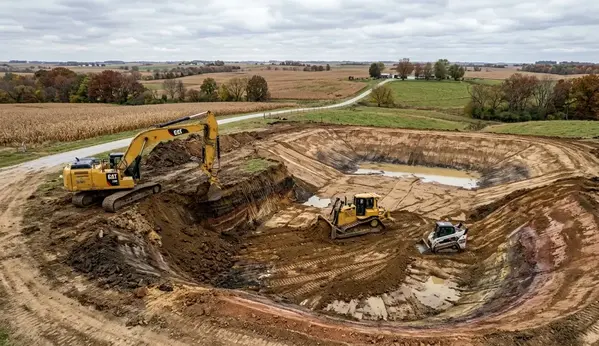
Proper pond construction requires controlled excavation, clay compaction, and precise shaping to ensure long-term water retention.
Before You Request a Quote
Every property is different, and choosing the right excavation contractor can have a lasting impact on how your land performs for years to come. If these priorities matter to you, we're likely a good fit for your project.
-
You Want the Job Done Right the First Time
Proper excavation begins with careful planning, accurate grading, and quality workmanship. Building it correctly from the start helps prevent expensive repairs and unnecessary rework later. -
You Care About Drainage and Long Term Land Performance
Water affects every excavation project. We evaluate drainage patterns, slopes, and soil conditions before construction begins to help protect your property long after the equipment leaves. -
Your Property Is Raw or Undeveloped
Whether the site contains timber, brush, uneven terrain, or untouched ground, we have experience preparing challenging properties for future construction and land improvements. -
You Value Honest Communication
We explain what your property needs, identify potential concerns, and provide straightforward recommendations so there are no surprises during the project. -
You Prefer Experience Over the Lowest Bid
Operating heavy equipment is only part of the job. Understanding drainage, grading, soil conditions, and site development is what creates results that last. -
You Want a Property Planned for the Future
Every grading decision influences future buildings, driveways, ponds, utilities, and drainage. We look at how your entire property will function, not just the immediate project.
The best excavation projects begin with careful planning, experienced operators, and a focus on long term performance. Our goal is to improve your property in a way that adds lasting value and helps prevent costly problems in the future.
Clear, Honest Excavation Pricing. No Guesswork.
Most land projects become expensive because problems are discovered after work has already started. We focus on understanding your property first, then building a realistic plan around your goals, site conditions, and budget.
Excavation pricing depends on more than just equipment time. Soil conditions, access, drainage requirements, slope, material removal, and site preparation all affect the final scope of work. A proper evaluation helps prevent surprises and unnecessary costs later.
Transparent Estimates
You receive a clear scope based on your actual property conditions, including access, soil, grading requirements, and the amount of work needed to complete the project correctly.
No Pressure Walkthroughs
We evaluate the site, discuss your goals, explain possible challenges, and help you understand your options before any decisions are made.
Clear Timeline Before We Start
You will understand the expected schedule, project steps, and factors that can affect timing before equipment arrives on your property.
Built for Rural Missouri Conditions
North Missouri properties often involve clay soils, uneven terrain, drainage concerns, wooded areas, and limited access. We plan around those challenges from the beginning.
Good excavation starts with good planning. By understanding the land before work begins, we help property owners avoid costly mistakes and create results that last.
Cheap Pond Work Usually Becomes Expensive Pond Repair
Most pond failures don’t show up right away. They creep in after a few heavy rains, a dry summer, or a couple freeze‑thaw cycles, and by then the damage is already done.
We see it all over North Missouri: ponds that looked “fine” the day the dozer left, but slowly turned into leakers, blowouts, or mud pits because the builder skipped the steps that actually matter.
Leaking Basins
Most leaks come from poor clay sealing or compaction done too fast. A basin might hold water for a season, then start dropping inches a day once the clay dries out or shifts.
Failed Spillways
When a big storm rolls through, all that runoff has to go somewhere. If the overflow pipe is too small or the spillway wasn’t built with enough fall and width, the water cuts into the dam and chews it apart. Most blowouts we fix started with a spillway that couldn’t handle a real rain.
Bank Erosion
Steep banks look good on day one but won’t hold up under livestock pressure or heavy runoff. Once erosion starts, it only gets worse, filling the pond with silt and eating away the shoreline.
Wrong Pond Placement
Some ponds never had enough watershed to stay full. Others were dug in sandy or mixed soil that can’t seal. Location mistakes are almost impossible to fix without major reconstruction.
Poor Clay Depth
Around here, some ground has excellent clay and some of it is nothing but loose, sandy fill. If nobody checks how deep the good clay runs before digging, the pond ends up sitting on soil that simply won’t seal or hold water the way it should.
Rushed Construction
When a pond is thrown together fast with no lift compaction, no proper shaping, no spillway planning, it might look finished, but it won’t last. Dirt work done in a hurry always shows later.
Pond Construction Pricing
These ranges are based on real pond projects across North Missouri. Final cost depends on clay quality, access, depth, and how much shaping the land needs to hold water long‑term.
Small Livestock Pond
$8,000 – $15,000
Basic water source for cattle or farm use. Straightforward excavation, shaping, and clay packing.
Medium Fishing Pond
$15,000 – $30,000
Deeper cut, better contours, stronger clay sealing, and improved water retention for fishing or recreation.
Large Multi‑Acre Pond
$30,000 – $60,000+
Heavy excavation, watershed shaping, dam building, spillway installation, and full site engineering.
What Affects Pond Construction Cost?
- Clay quality – poor clay means more sealing and compaction work
- Depth – deeper ponds require more excavation and haul‑off
- Size – acreage scale changes equipment time dramatically
- Access – tight or wooded sites increase mobilization and clearing
- Rock presence – breaking or ripping rock adds cost quickly
- Hauling distance – dirt export/import impacts pricing
- Spillway design – engineered overflow systems add complexity
Get a Real Number for Your Property
These ranges are starting points. Your actual cost depends on soil, access, and design. We’ll walk your land and give you a precise estimate.
Types of Pond Projects We Build Across North Missouri
No two pond sites behave the same in North Missouri. Clay depth, watershed size, runoff direction, elevation changes, and surrounding land use all affect whether a pond performs correctly long-term. These are the real-world pond projects we commonly build, restore, and excavate for farmers, acreage owners, hunters, and rural property owners throughout the region.
Livestock Water Ponds
Built for durability, reliable water retention, and controlled livestock access. We shape banks and pond depth to reduce erosion, minimize mud problems, and hold up against heavy cattle traffic and changing Missouri weather conditions. Many livestock pond projects are completed as part of larger farm and ranch development projects .
Fishing & Recreational Ponds
Designed with deeper water zones, contour variation, and long-term water stability for better fish habitat and cleaner water conditions. We also shape shorelines for easier access, dock placement, and future property enjoyment.
Water Retention & Runoff Control Ponds
Built to manage runoff, drainage overflow, and water movement across large rural properties. These ponds help reduce washouts, standing water problems, and uncontrolled erosion during heavy rain cycles common across North Missouri.
Pond Rebuilds & Dam Repairs
We restore leaking, shallow, or silted-in ponds by rebuilding damaged embankments, improving spillways, deepening basins, and reworking failed clay seals that no longer retain water properly.
Hunting Property Pond Development
Water access can completely change the value and usability of hunting land. We build ponds designed to improve wildlife activity, support habitat development, and create dependable water sources on rural recreational acreage. These projects often begin with selective land clearing and access improvements.
Full Property Access & Pond Site Preparation
Many pond projects also require clearing access roads, removing timber, stabilizing equipment paths, grading surrounding ground, and preparing the site so heavy excavation equipment can safely reach the build area.
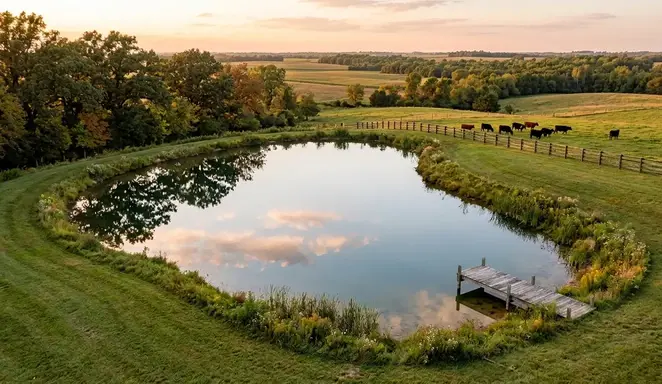
A properly built pond becomes a long-term asset for recreation, livestock, drainage control, and rural property value across North Missouri.
Recent Pond Projects in North Missouri
A few recent pond construction and repair projects across North Missouri. Each site required different soil handling, watershed planning, and long-term water retention solutions.
Chillicothe — Farm Pond Rebuild
Issue: Chronic clay seepage and ongoing water loss.
Work performed: Basin reworked, clay layers re-compacted, and hidden sand seams corrected during excavation.
Result: Full water retention restored with long-term stabilization of the pond structure.
Macon County — Livestock Pond Excavation
Issue: Needed a reliable water source for a 12-acre pasture operation.
Work performed: Complete excavation with reinforced banks and controlled livestock access points to reduce erosion.
Result: Durable agricultural pond designed for heavy cattle use and long-term performance.
Trenton — Fishing Pond Construction
Issue: Landowner wanted a recreational fishing pond with stable depth and healthy habitat.
Work performed: Deep basin excavation with contour shaping and improved shoreline grading.
Result: Stable water levels and improved fish habitat conditions year-round.
Brookfield — Spillway Repair Project
Issue: Spillway failure after a heavy storm event.
Work performed: Overflow system rebuilt, dam structure stabilized, and runoff channel regraded.
Result: Improved storm resistance and long-term protection of pond infrastructure.
Cameron — Drainage Retention Pond
Issue: Persistent field flooding and runoff control issues.
Work performed: Engineered retention basin designed to control agricultural runoff flow.
Result: Reduced flooding and improved usability of surrounding farmland.
Bethany — Timber Land Pond Excavation
Issue: Undeveloped wooded acreage with no existing water source.
Work performed: Full clearing, watershed mapping, and strategic pond placement for natural runoff capture.
Result: Self-sustaining pond with reliable long-term fill from natural drainage patterns.
What Actually Goes Into Building a Pond That Lasts
Good pond construction is part excavation, part water management, and part understanding how rural Missouri ground behaves over time. Most people only see the finished pond. What matters is the engineering underneath it.
Reading Soil Conditions
We evaluate clay density, moisture content, subsoil transitions, and hidden porous layers while excavating. Soil changes can happen fast across North Missouri properties, even within short distances.
Watershed Flow Analysis
We study how rainfall naturally moves across the property to determine whether the site can consistently feed and maintain the pond throughout seasonal weather cycles.
Clay Compaction & Sealing
Proper compaction is what creates long-term water retention. We compact clay in controlled layers so the basin seals tightly and reduces seepage over time.
Bank Slope Engineering
Pond banks that are too steep become unstable and dangerous. Proper slope design helps prevent erosion, improves access, and creates more stable long-term shoreline conditions.
Overflow & Spillway Protection
Every pond needs a safe way to handle major rain events. Spillway design protects the pond structure, surrounding land, and downstream property during heavy runoff periods.
Long-Term Durability Planning
We build ponds with long-term maintenance in mind, including erosion control, equipment access, livestock impact, and how the pond will behave five to ten years down the road.
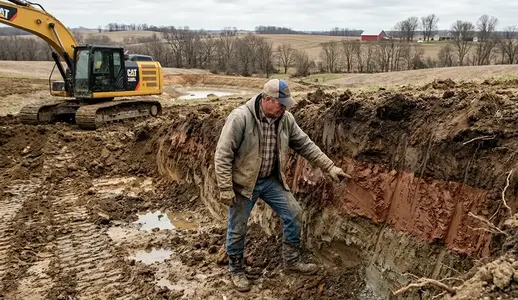
Every successful pond starts with understanding the clay underneath the surface. Soil conditions determine whether a pond holds water for decades or develops problems later.
Why Pond Construction in North Missouri Requires Local Experience
Pond construction in North Missouri is very different from building ponds in sandy southern ground or rocky terrain farther west. Around Chillicothe, Trenton, Bethany, Cameron, Brookfield, and surrounding rural areas, we regularly deal with heavy clay soils, hidden drainage paths, rolling watershed terrain, old farm tile systems, and aggressive seasonal runoff patterns.
That local experience matters because ponds here can look perfect during excavation and still fail later if the soil profile changes underneath the basin or runoff isn’t managed correctly. We pay attention to what’s coming out of the bucket while digging, where natural clay shelves sit, how surrounding fields drain during storms, and whether the watershed is strong enough to support the pond long-term.
A lot of pond failures across rural Missouri happen because somebody focused only on excavation volume instead of understanding the land itself. The goal isn’t just making the property look good after the equipment leaves. The goal is building a pond that still performs after years of drought cycles, heavy rains, livestock traffic, and seasonal ground movement.
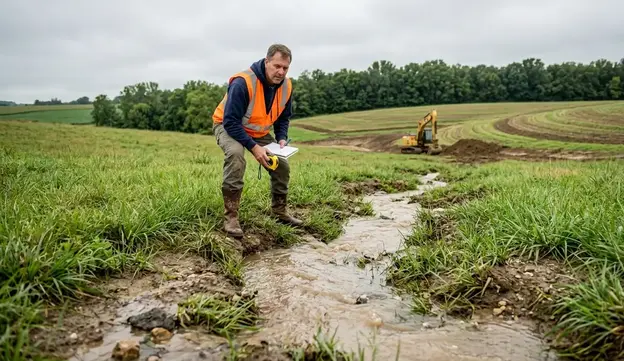
Understanding how water naturally moves across a property is often more important than the excavation itself.
Common Pond Problems We’re Called Out To Fix
A large percentage of pond work in North Missouri is fixing ponds that were poorly planned, rushed, or built without understanding how local soil and watershed conditions actually behave. These are some of the most common problems we see on rural properties throughout the region.
Ponds That Constantly Lose Water
Usually caused by poor clay compaction, porous subsoil exposure, hidden sand seams, or improper basin shaping. Many leaking ponds were never sealed correctly from the start.
Spillway Washouts After Heavy Rain
Improper overflow design can destroy pond edges, embankments, and nearby land during large storms. We redesign drainage flow and spillway systems to safely move excess water.
Shallow Ponds Filling With Silt
Poor watershed control allows runoff to continuously carry sediment into the pond basin. Over time, ponds lose depth, heat up faster, and become difficult to maintain.
Eroded Pond Banks
Steep grading, livestock traffic, and unstable shorelines create erosion problems that worsen every season. Proper shaping and stabilization prevent long-term structural damage.
Ponds Built in the Wrong Location
Some ponds simply never had enough watershed feeding them. We evaluate natural runoff patterns and terrain before excavation begins so the pond has a sustainable water source.
Clay Layers Cut Too Deep
Digging below usable clay can expose porous ground underneath the basin. Once that seal is broken, the pond may struggle to hold water no matter how much rain it receives.
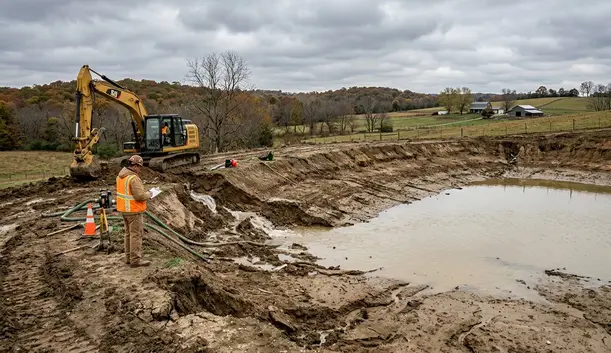
Many pond failures start underground long before visible damage appears. Identifying the root cause is the first step toward a permanent repair.
Not Sure Why Your Pond Is Failing?
Whether you're dealing with a leaking pond, erosion, sediment buildup, or fluctuating water levels, we can evaluate the site and identify what's actually causing the problem.
Schedule a Pond EvaluationSome Pond Sites Shouldn’t Be Built, And We’ll Tell You That Up Front
Not every piece of ground in North Missouri is automatically a good pond site. Sometimes the watershed is too weak. Sometimes the soil profile changes underneath the clay layer. Sometimes old field tile, sand seams, or poor drainage patterns make long-term water retention difficult without major correction work.
We’re not interested in digging a pond that becomes your headache two years later. If we think your property needs a different location, a redesign, additional clay work, or isn’t worth building at all, we’ll tell you honestly before equipment ever shows up.
That straightforward approach has saved a lot of landowners across North Missouri from spending serious money on ponds that were never going to perform correctly in the first place.
Build a Pond Designed Around Your Property
Whether you are planning a new farm pond, livestock water source, fishing pond, or water retention system, we evaluate your terrain, watershed flow, soil conditions, and drainage patterns to determine the right approach before excavation begins.
Schedule a Site EvaluationWhat Makes a Property Ideal for Pond Construction
Some land naturally supports pond construction better than others. The best pond sites usually combine strong watershed flow, quality clay, proper elevation changes, and stable surrounding ground conditions. Many pond sites also require land clearing , grading work , or site preparation before excavation can begin.
Natural Drainage Flow
Properties where runoff already funnels naturally into a low area usually perform best long-term.
Healthy Clay Content
Dense clay layers help create strong natural sealing conditions and improve long-term water retention.
Usable Watershed Size
A pond needs enough surrounding land feeding runoff into the basin to maintain stable water levels.
Stable Surrounding Terrain
Ground stability affects bank durability, spillway protection, and long-term erosion resistance.
North Missouri Clay Is the Key to a Successful Pond
A pond is only as reliable as the soil beneath it. Throughout North Missouri, clay quality can vary dramatically from one property to the next. Evaluating soil conditions before excavation helps determine whether a pond will retain water effectively for years to come.
-
Evaluating Existing Clay Deposits
Test cuts help determine the depth, consistency, and quality of available clay. Identifying suitable sealing material before excavation reduces the risk of future water loss. -
Proper Clay Compaction
Clay should be placed and compacted in controlled lifts to create a dense, uniform liner. Proper compaction improves water retention and helps the pond withstand seasonal moisture changes. -
Leak Prevention Through Basin Design
Pond shape is just as important as soil quality. Proper basin geometry distributes water pressure evenly and helps minimize seepage around slopes, corners, and transitions. -
Watershed and Runoff Management
A well-designed watershed supplies consistent water while protecting pond banks from erosion during heavy North Missouri rainfall events. -
Identifying Problem Soils
Sand, topsoil, organic material, and loose fill soils rarely provide an effective pond liner. Recognizing unsuitable materials early helps avoid expensive reconstruction later. -
Building for Long Term Performance
Combining quality clay, proper compaction, accurate grading, and sound engineering creates a pond that performs reliably through changing seasons and fluctuating water levels.
Successful pond construction begins below the surface. Proper soil evaluation, quality clay, careful compaction, and thoughtful basin design create ponds that retain water, resist erosion, and provide dependable long term performance.
How We Build Ponds That Hold Water
A successful pond requires more than excavation. Water retention depends on proper site evaluation, soil conditions, basin design, clay compaction, drainage control, and final stabilization. Every stage of the process is planned around the property's natural terrain to create a pond that performs reliably through changing seasons.
Site Evaluation & Watershed Planning
Every pond project begins by understanding how water moves across the property. We evaluate elevations, drainage patterns, watershed size, and soil conditions to determine the best location and design approach. Many projects begin with excavation site preparation before pond construction begins.
Pond Excavation & Basin Shaping
The pond basin is carefully excavated and shaped to match the property rather than forcing an unnatural design. Proper depth, side slopes, and shoreline transitions help improve stability, reduce erosion, and create a more functional pond system.
Clay Placement & Soil Compaction
Water retention depends heavily on the quality and placement of clay. Suitable clay is installed in controlled layers and compacted properly to create a dense sealing surface that helps prevent leaks and maintain consistent water levels.
Overflow & Spillway Installation
Heavy North Missouri rainfall can quickly overwhelm a poorly designed pond. Proper overflow systems and spillway construction safely direct excess water away from the dam while reducing erosion and protecting the surrounding property.
Final Grading & Erosion Control
The final stage focuses on shaping banks, stabilizing exposed soil, and preparing the surrounding landscape. Proper grading helps control runoff and follows the same principles used in professional grading and drainage projects.
Final Inspection & Performance Review
Before completion, the pond is reviewed for drainage flow, slope stability, erosion risks, and overall functionality. The goal is to deliver a pond system that looks natural while performing correctly for years.
Professional pond construction combines excavation, soil science, drainage planning, and careful finishing work. By building each layer correctly, we create ponds designed for reliable water retention, reduced maintenance, and long term property value.
Get a Realistic Pond Construction Estimate
Every pond site is different. Factors like watershed size, excavation volume, clay availability, spillway requirements, and access all affect cost.
Call (660) 371-5901 Get a Free QuoteWhy Some North Missouri Ponds Fail Within a Few Years
A pond can look perfect right after construction and still slowly fail underneath the surface. Most long-term pond problems start during excavation, not years later.
Poor Compaction
Dirt pushed around loosely with heavy equipment is not the same as properly compacted clay. Without layered compaction, water eventually finds weak spots and starts escaping through the basin or dam.
Weak Watershed Flow
Some ponds simply never receive enough runoff to stay full consistently. Watershed size matters just as much as excavation depth when building a long-term water source.
Improper Bank Angles
Banks that are too steep begin eroding after repeated storms, livestock traffic, and freeze-thaw cycles. Once shoreline erosion begins, sediment problems follow quickly.
Undersized Spillways
A single major Missouri rainstorm can destroy a poorly designed spillway. Overflow systems must safely move runoff without cutting into the dam or pond edges.
Digging Below Good Clay
Cutting too deep into porous material below the clay layer creates permanent seepage issues that are difficult and expensive to correct later.
Rushed Dirt Work
Fast excavation without careful shaping, sealing, grading, and stabilization almost always becomes expensive repair work later.
Pond Construction Service Area
We build and restore farm ponds, livestock ponds, fishing ponds, and rural water retention systems across North Missouri. Every property is different, so we design each pond around real watershed flow, clay conditions, and how your land naturally holds water, not a one-size template. Most of our work is on rural farms, acreage properties, hunting land, and new rural builds where long-term water retention actually matters.
From new pond excavation to fixing leaking or silted-in ponds, we work across the region helping landowners turn dry ground or unreliable water holes into ponds that actually hold through Missouri weather cycles.
Many pond projects are completed alongside grading and drainage improvements , land clearing , and farm development work to improve the entire property.
- Liberty, MO
- Smithville, MO
- Plattsburg, MO
- St. Joseph, MO
- Maryville, MO
- Chillicothe, MO
- Trenton, MO
- Hamilton, MO
- Gallatin, MO
- Cameron, MO
- Bethany, MO
- Princeton, MO
- Brookfield, MO
- Macon, MO
- Stanberry, MO
- King City, MO
- Albany, MO
- Jamesport, MO
- Lancaster, MO
- Unionville, MO
- Green City, MO
- Milan, MO
- Savannah, MO
- Rural North Missouri Farms, Acreage & Hunting Properties
If you’re anywhere in North Missouri with land that needs a new pond, a rebuilt pond, or better water control, we can come look at it, read the ground, and tell you straight whether it’s a good pond site or not.
What Separates Experienced Pond Builders From Someone Who Just Owns Equipment
Excavators are easy to rent. Understanding how to build a pond that survives North Missouri conditions is something completely different.
Real pond construction experience comes from understanding soil transitions, watershed behavior, compaction timing, runoff control, spillway protection, and how the land changes through years of weather cycles.
That experience matters because most serious pond problems aren’t visible the day the job finishes. They appear later after heavy storms, dry seasons, livestock pressure, erosion, or hidden soil weaknesses start showing up underneath the surface.
A Pond Changes More Than Just the Landscape
Across North Missouri, ponds are one of the most valuable long-term improvements a rural property owner can make. The right pond improves usability, strengthens land performance, supports livestock and wildlife, and adds long-term function to acreage that would otherwise sit unused.
Whether it’s a farm pond for cattle, a fishing pond for recreation, or a retention pond for runoff control, properly designed water systems change how the entire property works during every season.
Reliable Livestock Water
Reduce dependence on hauled water and create dependable access for cattle and agricultural use year-round.
Recreation & Family Use
Fishing ponds create long-term recreational value and become a centerpiece for rural family properties.
Better Hunting Ground
Wildlife activity increases dramatically when dependable water sources are added to hunting acreage.
Drainage Control
Retention ponds help manage runoff, reduce erosion, and improve stormwater control during heavy rains.
Increased Property Value
Professionally built ponds often improve land usability, visual appeal, and long-term resale value.
Long-Term Water Retention
Stored water becomes increasingly valuable during dry Missouri summers and changing seasonal weather patterns.
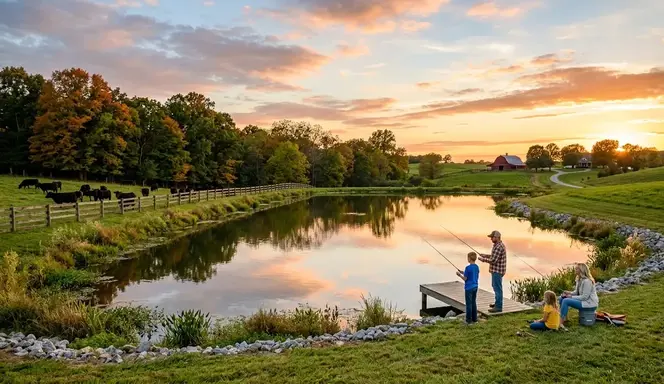
A properly designed pond becomes one of the most valuable and useful improvements a rural property owner can make.
Let's Talk About What You Want Your Pond To Do
Whether you're building a fishing pond, livestock pond, hunting property water source, or retention pond, we'll help design a solution that fits your land and long-term goals.
Call Today (660) 371-5901Most Pond Problems Start Underground Where Nobody Can See Them
A pond can look clean and professionally finished on the surface while serious long-term problems are already developing underneath the basin.
That’s why experienced pond construction is less about moving dirt fast and more about understanding what the soil, watershed, and ground conditions are doing during excavation.
Across North Missouri, we regularly see ponds fail because the builder chased speed instead of paying attention to clay transitions, runoff behavior, compaction timing, or hidden porous material underneath the basin.
Most of those issues don’t appear immediately. They show up later after storms, drought cycles, livestock pressure, or years of water movement slowly expose the weak points underneath the pond.
Clay Layer Awareness
We monitor changing soil conditions during excavation instead of assuming the entire site behaves the same underground.
Watershed Planning
Proper runoff flow and overflow protection are critical for long-term pond survival during heavy Missouri storms.
Controlled Compaction
Tight layered compaction helps reduce seepage and creates stronger long-term basin sealing conditions.
Long-Term Durability
The goal is building a pond that still performs years from now, not one that only looks good when the equipment leaves.
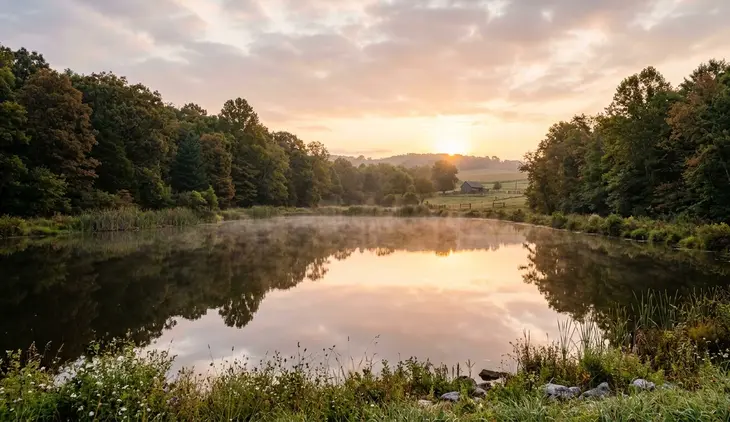
When a pond is built correctly, it becomes a stable long-term feature of the land, not a maintenance problem.
Frequently Asked Questions About Pond Construction in North Missouri
Around North Missouri, pond work isn’t just digging a hole and letting it fill up. Soil conditions, clay content, watershed flow, and how the land “feeds water” all determine whether a pond holds strong for 30 years or turns into a leaking pit after the first dry spell. These are the real questions we get out on farms, acreages, and rural build sites.
- What makes a pond actually hold water in North Missouri soil?
- It comes down to clay content, compaction, and how the basin is shaped. In this region, we’re lucky to have decent natural clay in a lot of ground, but it has to be worked right. A proper pond isn’t just excavated, it’s keyed into clay layers, compacted in lifts, and shaped so water pressure seals the basin over time. If you miss that part, you’ll fight seepage no matter how deep you dig. This is the difference between a pond that stays full and one that slowly disappears every summer.
- Why do some farm ponds leak even when they look “done right”?
- Most leaking ponds come from one of three issues: wrong soil mix, poor compaction, or cutting through a clay layer into porous subsoil. We also see a lot of ponds built too fast without letting the basin “seal” properly. In North Missouri, even small pockets of sand, gravel seams, or buried topsoil can create hidden leak paths. That’s why experienced operators read the soil as they dig, not just the surface, but what’s coming out of the bucket.
- How do you decide where a pond should go on my property?
- We look at how water naturally moves across your land first. The best pond sites usually sit in a natural drainage path or low watershed pocket where runoff already wants to collect. We also check elevation, slope, access for equipment, and whether upstream runoff will actually sustain the pond through dry stretches. A lot of failed ponds are just placed in the wrong spot from the start.
- Can you build a pond on flat ground or farmland?
- Yes, but it takes more shaping and sometimes more hauling. Flat ground doesn’t naturally “feed” a pond, so we often have to create a watershed or contour drainage paths to direct water into it. On old farmland, we also deal with compacted topsoil layers and hidden tile lines, which can change how water moves underground. It’s doable—it just has to be engineered instead of guessed.
- How long does it take for a new pond to fill up?
- It depends entirely on rainfall and watershed size. Some ponds start collecting water immediately after the first rain, while others take a full season to stabilize. In dry stretches, it can take several heavy rain events to fully charge a new pond. We always explain this up front so landowners know what “normal fill time” looks like in this region.
- Do you build livestock ponds and fishing ponds differently?
- Yes. Livestock ponds are usually designed for durability, easy access, and controlled water depth for cattle or farm use. Fishing or recreational ponds are shaped differently with deeper sections, gradual banks, and structure zones that support fish habitat. Same dirt work principles—but very different end goals.
- What happens if my property doesn’t have good clay for sealing?
- That’s something we identify early. Some sites need imported clay, basin conditioning, or selective compaction to help the pond hold water. In tougher cases, we’ll reshape the design or adjust depth to stay within usable clay layers. We don’t push a pond where the ground won’t support it long-term, that’s how you end up with constant maintenance issues.
- Do ponds need maintenance after they’re built?
- Minimal, but not zero. Most well-built ponds just need occasional dam inspection, spillway checks after heavy storms, and keeping trees off embankments. The biggest long-term issue we see is erosion on the spillway or cattle traffic damaging banks. If it’s built right from the start, maintenance stays simple.
- Can you fix or rebuild an old pond that’s leaking or silting in?
- Yes. A lot of our work comes from restoring older ponds that have filled with sediment, lost depth, or started leaking. We evaluate whether it needs re-compaction, deepening, spillway repair, or full re-shaping depending on what’s happening underground. In many cases, a rebuild is cheaper than trying to patch repeated leaks.
- Do you handle permits or regulations for pond construction?
- Some sites do require county or watershed approval, especially if you’re working near drainage channels, modifying runoff, or building larger impoundments. We help point you in the right direction so you’re not guessing what’s required before digging starts. Most rural farm ponds in North Missouri are straightforward, but it depends on the location and water flow.
- How do I get an accurate estimate for a pond project?
- The only real way is walking the ground. We look at soil type, watershed flow, access for equipment, and elevation changes. Every pond site behaves differently, two properties a mile apart can require completely different approaches. Once we see the land, we can give you a realistic build plan and cost range based on how your soil actually behaves, not guesses.
Get Your Pond Built Right the First Time
If you want a pond that actually holds water and doesn’t turn into a headache later, it starts with the right crew and the right equipment on the ground.
Call Now (660) 371-5901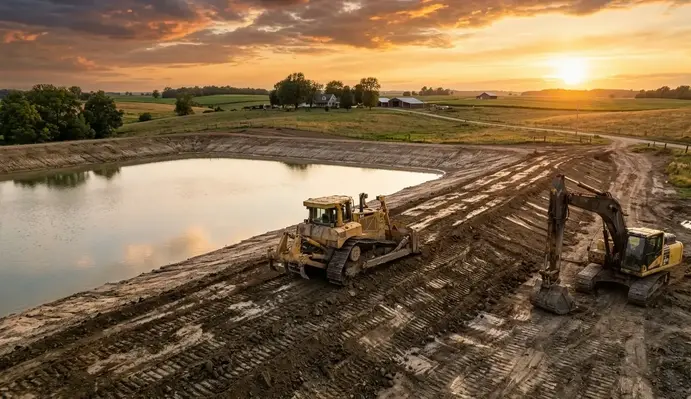
Long-term pond performance starts with proper grading, compaction, and experienced excavation work done right from the beginning.