
Farm & Ranch Site Development in North Missouri
From barn pads and livestock ponds to pasture roads, fencing layout prep, drainage correction, and full ranch infrastructure development, we help turn raw acreage into functional, working farm ground built for real agricultural use.
Serving Chillicothe, Kirksville, Cameron, Trenton, Bethany, Moberly, St. Joseph, Maryville, Brookfield, Macon, Princeton, Hamilton, Gallatin, Milan, Albany, Unionville, Savannah, and surrounding North Missouri farm and ranch communities.
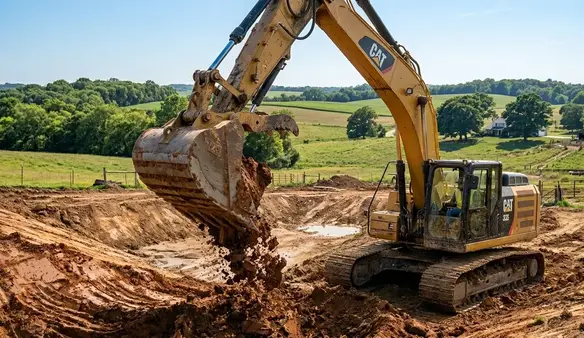
Farm & Ranch Site Development Services
Farm Pond Excavation
Livestock, irrigation, and wildlife ponds built for Missouri clay soils and watershed retention.
Livestock Water Systems
Reliable water access systems for cattle, pastures, rotational grazing, and remote water points.
Farm & Field Roads
Graded access roads built to handle tractors, feed trucks, trailers, and wet‑season traffic.
Creek Crossings & Culverts
Engineered crossings designed for runoff control, erosion resistance, and heavy equipment access.
Fence Line Clearing
Brush, timber, and boundary clearing for pasture expansion, fencing installs, and property access.
Ranch Pads & Infrastructure
Barn pads, shop pads, equipment pads, and full ranch development layouts built for long‑term use.
Drainage & Water Control
Runoff correction, ditch shaping, erosion repair, and water redirection for wet or failing ground.
Land Grading & Slope Correction
Regrading uneven terrain, eliminating low spots, and shaping land for barns, pastures, and access.
Pasture & Field Improvements
Reshaping fields, removing obstacles, improving drainage, and preparing ground for grazing or crops.
Erosion Repair & Washout Fixes
Stabilizing slopes, repairing washed‑out roads, and preventing future damage from runoff.
Land Shaping & Property Cleanup
Removing old fence rows, leveling rough ground, reclaiming overgrown areas, and restoring usable acreage for grazing or equipment access.
Rock, Gravel & Material Placement
Delivery and placement of base rock, gravel, screenings, and fill material for roads, pads, gateways, and high‑traffic livestock areas.
Why North Missouri Farm Ground Requires Different Excavation Methods
Farm development in North Missouri isn't the same as building on suburban lots or commercial property. Much of the region is made up of heavy clay soils, rolling pasture terrain, seasonal waterways, watershed-fed drainage systems, and agricultural ground that experiences constant equipment and livestock traffic.
What works in other parts of Missouri often fails here because North Missouri ground behaves differently. Successful excavation projects require understanding how local soil conditions react to moisture, compaction, weather cycles, and long-term agricultural use.
Heavy Gumbo Clay Soils
Much of North Missouri contains dense clay soils commonly referred to as gumbo clay. When dry, this material can become extremely hard. When saturated, it becomes slick, unstable, and difficult to work with. Proper moisture management and compaction techniques are critical for roads, building pads, and pond construction.
Freeze-Thaw Cycles
Missouri winters create repeated freeze-thaw cycles that stress roads, culverts, drainage structures, and improperly compacted fill. Ground movement during winter months often exposes weaknesses that were hidden during construction.
Spring Saturation
Spring rainfall can quickly saturate clay soils across farm ground. Areas that appear stable during summer often become soft and problematic during wet months. This is one reason drainage planning must happen before excavation begins.
Agricultural Tile Drainage
Many North Missouri farms contain existing tile systems that influence water movement beneath the surface. Excavation projects must account for existing drainage infrastructure to prevent flooding, washouts, and future water-management problems.
Livestock Traffic Pressure
Cattle repeatedly follow the same travel paths to ponds, feeding areas, water systems, and gates. Without proper grading and reinforcement, these routes often become mud holes, erosion channels, and maintenance headaches.
Rolling Pasture Terrain
Unlike flat agricultural regions, many North Missouri properties contain rolling terrain that concentrates runoff into draws, creek bottoms, and low areas. Understanding how water moves across elevation changes is critical for long-term site performance.
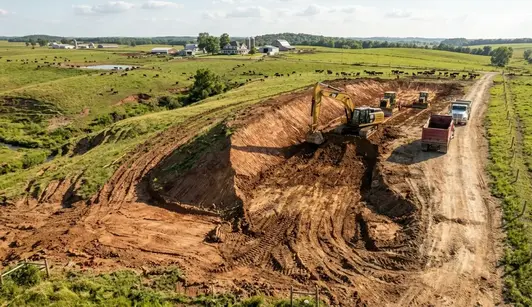
North Missouri's clay-heavy soils, rolling terrain, and seasonal drainage patterns require excavation methods designed specifically for agricultural ground and long-term farm use.
Common Farm Ground Problems We See Across North Missouri
Most landowners don't call us because they want excavation work. They call because something on the farm isn't working the way it should. In many cases, the visible problem is only a symptom of a larger grading, drainage, soil, or water-management issue beneath the surface.
Farm Roads That Wash Out Every Spring
One of the most common calls we receive involves roads that require fresh gravel after every major rain. In most cases, the issue isn't the gravel itself. The real problem is poor drainage, lack of crown, undersized culverts, or water being allowed to travel directly down the roadway.
Ponds That Won't Hold Water
Many livestock ponds across North Missouri lose water because they were built without adequate clay sealing, proper compaction, or sufficient watershed analysis. What appears to be a leaking pond is often a construction or soil issue that can be corrected with proper excavation methods.
Barn Pads That Settle After Construction
Settlement typically occurs when fill material wasn't properly compacted, moisture conditions weren't controlled, or drainage was ignored during construction. Once concrete is poured, these problems become significantly more expensive to fix.
Wet Pasture Areas That Never Dry Out
Standing water often indicates poor surface drainage, blocked outlets, low spots, or concentrated runoff patterns. Wet ground reduces grazing productivity, creates equipment access issues, and can eventually develop into erosion problems.
Creek Crossings That Erode Or Wash Out
Many crossings are undersized for the watershed feeding them. During heavy rain events, water overtops the crossing, damages approaches, and eventually destroys the structure. Proper sizing and grading are critical for long-term performance.
Cattle Lots That Turn Into Mud Holes
Heavy livestock traffic combined with poor drainage creates muddy conditions that increase maintenance, reduce usability, and contribute to livestock health issues. Proper grading, drainage improvements, and traffic-area stabilization can dramatically improve conditions.
The good news is that most of these problems can be corrected when the underlying cause is properly identified. That's why every project starts with evaluating how water, soil, terrain, equipment traffic, and livestock use interact across the property.
Don’t Wait for These Problems to Get Worse
Drainage issues, road washouts, pond leaks, and barn pad failures typically become significantly more expensive after additional seasons of weather and equipment use.
How Small Farm Problems Turn Into Expensive Repairs
Most farm infrastructure failures don’t happen all at once. Minor issues that seem harmless during a dry season often grow worse with every rain event, freeze–thaw cycle, and equipment pass, until the repair becomes far more costly than it needed to be.
Road Rutting
Small ruts trap water, softening the road base. As equipment continues to travel the same path, the weakened section collapses, eventually requiring full-depth reconstruction instead of simple grading.
Standing Water
A shallow low spot slowly expands as saturated soils lose structure. Over time, the wet area spreads, reducing usable pasture, stressing livestock traffic routes, and increasing erosion around the perimeter.
Pond Leaks
Minor seepage often indicates a developing failure in the dam core or basin. As water follows the weak zone, the leak enlarges, turning what could have been a small repair into a major rebuild.
Erosion Channels
A narrow runoff path deepens with every storm. Left unchecked, it becomes a washout that damages roads, fences, culverts, and pasture ground, often requiring heavy equipment to correct.
Soft Spots in Pasture or Roads
Areas that feel slightly soft under equipment or livestock usually indicate poor subgrade support or hidden drainage issues. Over time, these spots collapse, creating ruts, sink areas, or structural failures.
Undersized or Failing Culverts
A culvert that barely handles normal flow will eventually clog or wash out during heavy rain. Once the crossing fails, the repair often requires replacing the pipe, rebuilding the road, and reshaping the drainage.
The most affordable time to fix farm infrastructure is when the issue first appears, not after multiple seasons of weather, livestock pressure, and equipment traffic have multiplied the damage.
Livestock Ponds Built For North Missouri Cattle Operations
Many livestock ponds fail because they were dug where water collects rather than where the watershed actually supports long‑term retention. A pond that fills after a rain isn’t the same as a pond that holds water through July.
We evaluate watershed size, clay availability, livestock access points, overflow protection, and long-term maintenance requirements before excavation begins. Many farm pond projects begin with proper pond construction and excavation planning to ensure reliable water retention through Missouri summers. A proper livestock pond is engineered, not guessed.
- Cattle watering ponds designed for year‑round reliability
- Rotational grazing ponds placed for efficient herd movement
- Pasture watering systems with controlled access points
- Emergency water storage for drought resilience
- Dual‑purpose livestock and fishing ponds with balanced depth profiles
North Missouri clay behaves differently than most regions. Without proper compaction, a clay core, and a correctly sized watershed, even a brand‑new pond can leak, slump, or dry out. We build ponds that last, not ponds that look good for a season.
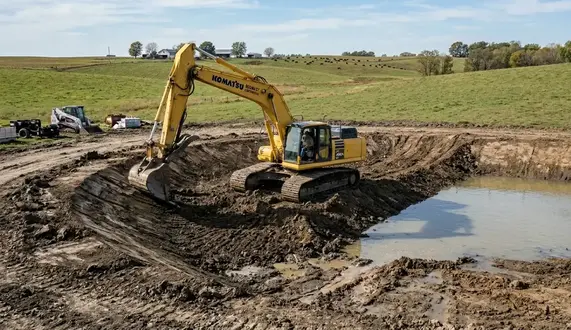
Proper livestock ponds begin with watershed evaluation, clay analysis, and long-term water retention planning, not simply digging a hole where water collects.
Thinking About Building a Livestock Pond?
We evaluate watershed flow, clay content, and spillway design to ensure long-term water retention for livestock and agricultural use.
Cattle Water Systems & Remote Water Access
One of the biggest challenges on larger cattle operations is keeping reliable water available without forcing livestock to travel long distances, concentrate around a single pond, or damage pond banks through repeated traffic. Strategic water placement improves grazing efficiency, supports rotational grazing programs, reduces stress on livestock, and helps distribute grazing pressure more evenly across the property.
Many livestock watering projects begin with a properly designed farm pond that serves as the primary water source for remote pasture systems. Once water is available, the next challenge becomes getting it where cattle actually need it without creating mud problems, erosion, or excessive wear on the surrounding pasture.
We excavate and prepare infrastructure for cattle water systems, remote pasture watering locations, freeze-resistant watering areas, waterline routes, and livestock access improvements that help operations function more efficiently throughout the year.
- Rotational grazing water points
- Remote pasture watering systems
- Pond-fed livestock water infrastructure
- Waterline trenching preparation
- Heavy-use livestock traffic areas
- Mud reduction around watering locations
- Freeze-resistant watering site preparation
- Water access improvements for larger grazing systems
Across North Missouri, we often see cattle operations where livestock travel significant distances to reach water. This concentrates grazing pressure around ponds and watering areas while leaving other pasture sections underutilized. Properly positioned water access points can improve pasture utilization, reduce erosion around pond edges, and make rotational grazing systems easier to manage.
Watering locations also need to be designed with drainage in mind. Without proper grading, heavy-use areas around tanks and waterers can quickly become mud holes during wet periods. We shape and prepare these areas to improve drainage, reduce maintenance, and create more durable livestock traffic zones that hold up through changing Missouri weather conditions. In many cases, these improvements are paired with utility trenching services for waterline installation and drainage corrections to keep livestock areas functional year-round.
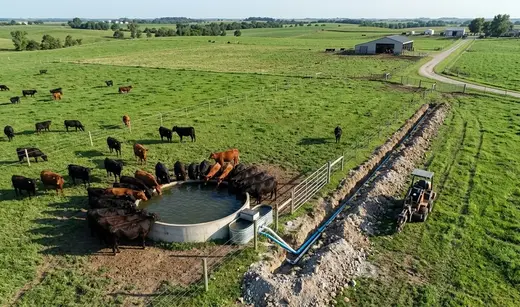
Strategic water placement helps reduce livestock travel distances, improve grazing distribution, and prevent excessive wear around ponds and high-traffic cattle areas.
Farm Roads Built To Handle Equipment Traffic
Most farm roads work fine until the first wet spring, grain harvest, or feed delivery. Then the ruts start. Water begins running down wheel tracks. Rock disappears into soft subgrade. Before long, equipment is driving around problem areas instead of through them.
A properly built farm road starts long before gravel is spread. We evaluate drainage patterns, soil conditions, traffic loads, slope percentages, and seasonal moisture cycles before determining the correct construction method.
Many North Missouri farms have roads originally built for pickups and small tractors that now need to support combines, grain carts, feed trucks, livestock trailers, fertilizer deliveries, and heavier modern equipment.
Grain Truck Access
Roads designed to withstand loaded grain trucks during harvest without rutting, pumping, or edge failure.
Feed Truck Routes
Reliable all‑weather access to feeding areas, barns, and livestock facilities, even during wet seasons.
Road Crowns
Proper shaping that sheds water off the roadway instead of allowing it to stand or follow wheel tracks.
Culvert Installation
Correctly sized and placed culverts that prevent washouts and maintain drainage beneath farm roads.
Subgrade Stabilization
Strengthening weak or saturated soils so the road base stays firm under heavy equipment loads.
Ditch & Drainage Shaping
Proper ditch grading that moves water away from the road instead of letting it pool, saturate, and destroy the base.
One of the biggest mistakes we see is adding more gravel to a failing road without addressing the underlying drainage problem. Water is almost always the real issue. When drainage is corrected first, roads last significantly longer and require far less maintenance.
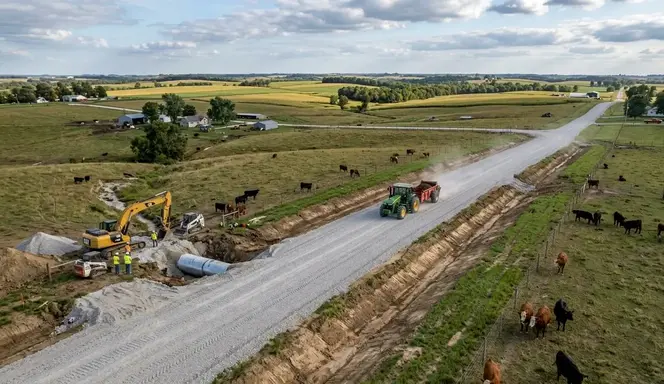
Well-built farm roads depend on proper grading, drainage control, and stable road bases that withstand tractors, grain trucks, feed deliveries, and year-round agricultural traffic.
Creek Crossings & Culverts That Survive Heavy Rain
Many rural properties depend on creek crossings for access to pasture, hay ground, hunting acreage, or livestock areas. Unfortunately, crossings are often undersized and become a recurring maintenance problem after every major storm.
A crossing that works during normal conditions may become completely impassable after a heavy rain event if water flow, drainage area, and erosion forces aren't properly accounted for.
- Farm creek crossings
- Low water crossings
- Culvert installation and replacement
- Equipment access crossings
- Pasture access improvements
- Erosion-resistant crossing construction
Recent projects across Livingston, Linn, and Sullivan Counties have involved replacing undersized culverts that repeatedly washed out during spring storms. In many cases, increasing capacity and improving approach grading eliminated years of recurring repairs.
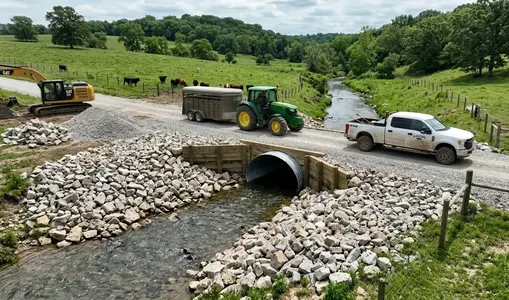
Properly designed creek crossings allow equipment, livestock, and farm traffic to move safely across waterways while minimizing erosion and washout risk.
Barn Pads Built For Long-Term Stability
Few farm projects become more expensive than a building pad that settles after construction. Once concrete is poured and structures are built, correcting settlement issues becomes significantly more difficult.
North Missouri clay soils can provide excellent support when properly prepared. However, moisture management, compaction procedures, fill placement, and drainage control all play major roles in long-term performance.
- Hay barn pads
- Equipment shed pads
- Machine shop pads
- Livestock facility pads
- Grain storage pads
- Agricultural building site preparation
Every pad should be designed around future use. Equipment storage, livestock facilities, hay storage, and workshops all create different loading requirements that influence how the pad is constructed.
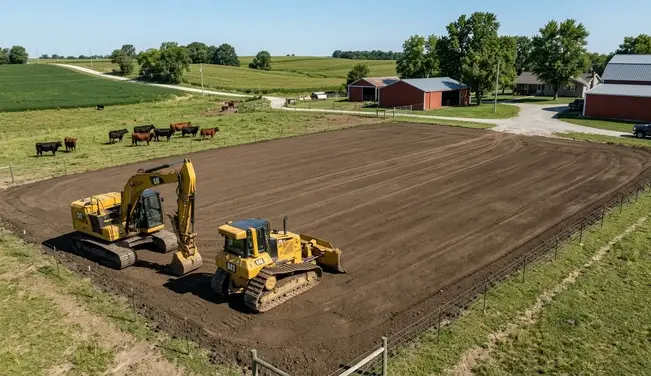
Properly compacted barn pads help prevent settlement, drainage problems, and structural issues that often appear years after construction.
Building a Barn, Shop, or Equipment Building?
The quality of the pad determines the long-term performance of the structure. Proper grading, compaction, drainage planning, and moisture control help prevent settlement issues that can become costly to repair later.
What You Should Know Before Starting a Farm or Ranch Project
Most expensive farm site problems happen before construction even starts. Here’s what experienced landowners check first.
- Where water naturally flows during heavy rain (not just dry conditions)
- Which areas stay soft 48–72 hours after rainfall
- How equipment currently enters and exits the property
- Whether existing roads already show rutting or edge collapse
- If pastures have low pockets that collect seasonal water
- Whether soil changes from firm to slick within short distances
If these aren’t evaluated early, most projects end up being rebuilt or corrected within 1–3 seasons.
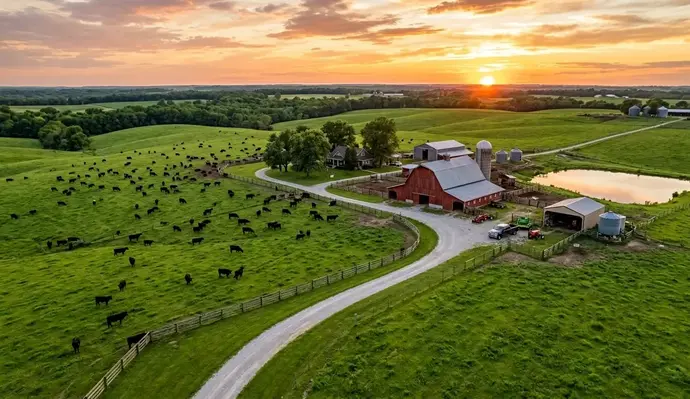
Successful farm development isn't measured by how much dirt gets moved. It's measured by how the land performs through years of livestock traffic, weather cycles, and agricultural production.
Real Farm & Ranch Work Across North Missouri
This isn’t theory work, it’s ground we’ve actually fixed after others got it wrong. Washed‑out pasture roads, sinking barn pads, ponds that wouldn’t hold water, drainage failures that turned usable acreage into swamp ground. Most of our projects come from referrals on active farms, not marketing leads, because word travels fast when the work holds up through a North Missouri winter.
Recent Work Areas
Linn County • Randolph County • Livingston County • Macon County • Grundy County • Sullivan County • Chariton County • Clinton County • Andrew County • Daviess County • Nodaway County
Common Calls We’re Getting
Fixing failed barn pads, rebuilding pasture roads after rain damage, correcting pond leaks, restoring usable cattle ground, and solving drainage issues that have been ignored for years.
Farm‑First Approach
We design for equipment weight, seasonal moisture, livestock traffic, and long‑term land use, not just “dirt work completion.” Our goal is simple: build farm infrastructure that survives weather, machinery, and time.
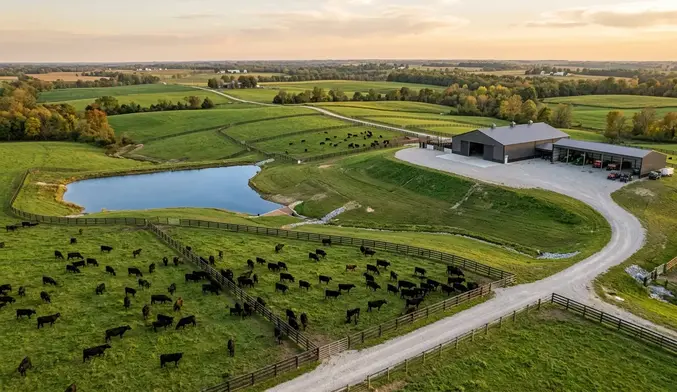
Many of our projects combine pond construction, road building, drainage improvements, and livestock infrastructure into one long-term ranch development plan.
North Missouri Farm & Ranch Development Service Area
We provide farm and ranch excavation services across North Missouri, where soil conditions, drainage patterns, and agricultural use vary significantly from county to county. From rolling cattle ground to heavy clay crop fields and low-lying watershed zones, each property requires site-specific planning to ensure long-term usability and performance.
Our work across the region includes livestock pond construction, pasture drainage correction, farm roads, creek crossings, building pads, erosion control, and full acreage development. Every project is designed around how water moves, how equipment accesses the land, and how the property is used year-round.
Daviess & Harrison Counties
Rolling pasture ground, clay soils, livestock ponds, seasonal drainage channels, and farm access improvements near Gallatin and Bethany.
Gentry & Nodaway Counties
Large agricultural tracts, erosion control, and farm road development supporting crop and cattle operations near Albany and Maryville.
Mercer & Grundy Counties
Livestock water systems, pond excavation, pasture restoration, and drainage corrections in active agricultural zones around Princeton and Trenton.
Livingston & Caldwell Counties
Grading, culvert installation, farm roads, and site prep work focused on water management near Chillicothe and Kingston.
Clinton & DeKalb Counties
Building pads, driveway construction, farm road upgrades, and drainage solutions protecting productive acreage near Cameron and Plattsburg.
Linn & Macon Counties
Barn pads, livestock ponds, pasture roads, erosion control, and mixed clay pasture development on working farm ground.
Sullivan & Chariton Counties
Pasture development, pond shaping, fence line clearing, and agricultural access improvements across mixed-use farmland.
Putnam & Adair Counties
Ranch infrastructure, barn pads, long-term site planning, drainage correction, and full acreage layout development.
Schuyler & Randolph Counties
Small farm improvements, erosion control systems, grading, drainage correction, and rural access road construction.
From northern river bottoms and clay-heavy crop fields to upland pasture and mixed livestock operations, North Missouri land requires precise excavation methods tailored to local soil behavior, water flow, and agricultural use.
Not seeing your county? If your property is anywhere in North Missouri, we can evaluate soil conditions, drainage patterns, and access needs to design a development plan specific to your land.
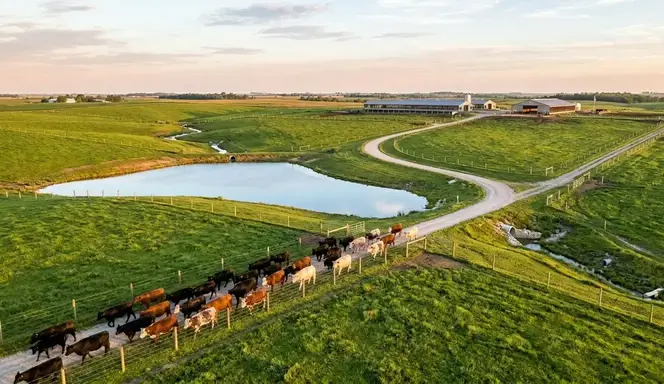
Farm infrastructure only matters if it improves daily operations. Roads, ponds, fencing access, and drainage systems all need to work together.
Built for Working Farms, Ranches & Rural Acreage
Farm and ranch land isn’t just property, it’s a working system. Every barn pad, fence line, pasture road, and pond has to function under real-world conditions: heavy equipment, livestock traffic, seasonal rain, and Missouri clay soil movement.
That’s why proper site development matters. We don’t just move dirt, we design usable ground that supports long-term agricultural operations.
We handle full rural development including:
5 Costly Mistakes Landowners Make Before Calling Us
Most expensive excavation problems don't start with bad intentions. They start with assumptions. Over the years we've been called to farms, ranches, and rural properties across North Missouri after a project didn't perform the way the owner expected. In many cases, the repairs cost significantly more than addressing the issue correctly from the beginning.
These are the five mistakes we see most often.
1. Choosing The Cheapest Excavation Bid
A lower price often means corners are being cut somewhere. It may be fewer machine hours, inadequate compaction, undersized drainage infrastructure, or limited site evaluation. The problem is that shortcuts usually don't become visible until months later when roads rut, water collects, or structures begin settling.
2. Building Before Understanding Water Flow
Water determines how every farm property functions. We've seen barn pads placed directly in seasonal drainage paths, livestock areas turn into mud holes, and access roads repeatedly wash out because runoff wasn't considered before construction started.
3. Underestimating Missouri Clay Soils
North Missouri clay can be an excellent building material when handled correctly. It can also create major problems when moisture, compaction, and drainage aren't properly managed. What appears solid during dry conditions may behave completely differently during a wet spring.
4. Building Roads For Today's Traffic Instead Of Tomorrow's
Many rural roads are designed around current needs rather than future use. A road that works for a pickup truck may not hold up once livestock trailers, feed deliveries, tractors, grain trucks, or larger equipment begin using it regularly.
5. Waiting Too Long To Fix Small Problems
Minor erosion, standing water, rutting, and drainage issues rarely improve on their own. What starts as a small washout can eventually damage roads, fences, culverts, ponds, and valuable pasture ground. Early correction is almost always less expensive than major reconstruction later.
What We Look For During A Site Visit
Before recommending any solution, we evaluate drainage patterns, soil conditions, elevation changes, equipment access routes, watershed behavior, and long-term land use goals. The objective isn't simply completing an excavation project, it's creating infrastructure that continues performing years from now.
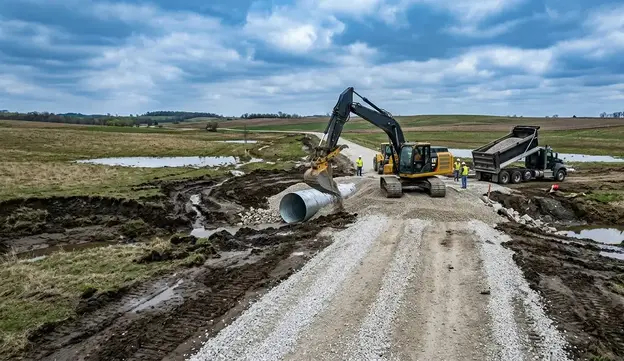
Most expensive farm problems start with water. Drainage failures often lead to road damage, erosion, pond issues, and loss of productive acreage.
Seeing Any Of These Problems On Your Property?
Standing water, washed-out roads, muddy livestock areas, settling building pads, and erosion problems rarely fix themselves. A site visit can identify the root cause before the damage spreads and repair costs increase.
Recent Farm Problems We've Been Called To Fix
Many of the projects we handle aren't brand-new developments. They're repairs and corrections after years of drainage issues, failed road construction, pond problems, or poor site planning.
- Pasture roads washing out after every major rain event
- Livestock ponds losing water due to improper clay sealing
- Barn pads settling and creating structural concerns
- Pasture ground becoming unusable from standing water
- Equipment access routes turning into mud during wet seasons
- Fence lines becoming erosion channels after clearing
- Creek crossings failing under farm traffic
In many cases the original construction wasn't necessarily done poorly. The property simply wasn't designed around how water, equipment, and Missouri soil behave over time.
What Makes Farm Development Projects Cost More?
One of the biggest misconceptions landowners have is assuming acreage determines cost. In reality, acreage is often one of the smallest pricing factors.
The largest cost drivers are usually:
- How far material must be moved across the property
- Existing drainage and water-management challenges
- Clay content and soil stability
- Amount of clearing required before excavation begins
- Availability of on-site fill material
- Creek crossings, culverts, and erosion-control requirements
- Access limitations for heavy equipment
- Whether we're building new infrastructure or correcting failed work
Two farms with the same acreage can differ dramatically in development cost depending on terrain, drainage behavior, and site conditions.
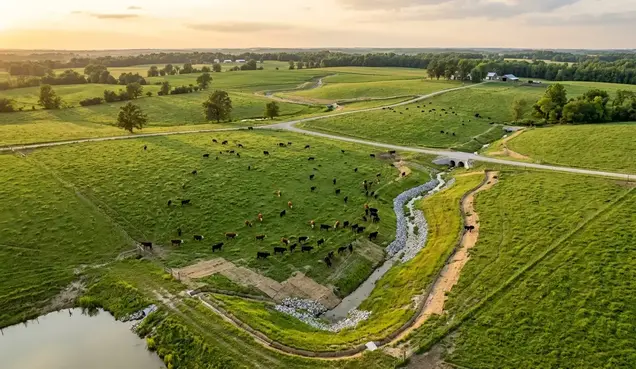
Proper water management often turns chronically wet ground back into productive grazing acreage while reducing erosion and maintenance costs.
Get Real Pricing For Your Farm Project
Every farm is different. Soil conditions, drainage, access routes, pond locations, and grading requirements all affect pricing. The fastest way to get accurate numbers is an on-site evaluation.
Request A Farm Site EstimatePasture Drainage Problems Don't Fix Themselves
Standing water costs farmers more than they realize. Saturated ground reduces usable grazing acreage, damages equipment access routes, creates livestock health concerns, and accelerates erosion. What looks like “just a wet spot” is often a sign of deeper grading problems, watershed issues, or inadequate water retention planning.
Across North Missouri we frequently see low areas that remain wet long after surrounding ground has dried. These areas often indicate drainage bottlenecks, blocked outlets, poor grading, or runoff concentration issues, all of which get worse over time if left untreated.
Common Drainage Solutions We Provide
- Pasture drainage correction for chronically wet ground
- Wet area reclamation to recover lost grazing acreage
- Surface water management to redirect runoff safely
- Water diversion grading to prevent pooling and rutting
- Erosion control improvements for slopes and washout zones
- Field drainage solutions for crop ground and hay fields
Correcting drainage issues can often recover productive acreage that has been unusable for years, reduce equipment wear, and prevent long‑term soil degradation. When water is managed correctly, the entire farm becomes more efficient and easier to maintain.
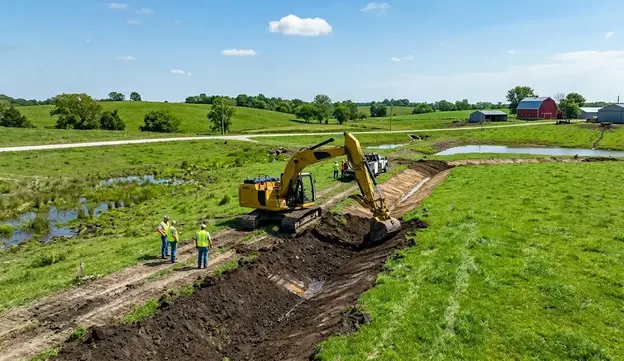
Proper drainage improvements can reclaim productive grazing acreage, reduce standing water, and prevent long-term erosion across agricultural properties.
What We Evaluate Before Recommending Any Farm Development Project
Every farm has its own terrain, soil behavior, and water movement patterns. Before we recommend a pond site, road layout, building pad, drainage correction, or grading plan, we study how the entire property functions as a working agricultural system, not just a construction site.
- How natural drainage channels move water during heavy rain and drought cycles
- Existing waterways, watershed boundaries, and how runoff concentrates across the landscape
- Soil structure, clay depth, and material suitability for compaction, pond cores, and road bases
- Active erosion zones and areas where soil loss is already impacting productivity
- Condition and placement of existing culverts, crossings, and low-water areas
- Equipment traffic patterns that influence compaction, ruts, and long-term access needs
- Livestock travel routes that affect mud formation, erosion, and water access efficiency
- Future building or expansion areas that require stable foundations and proper drainage
- Water availability, retention potential, and whether the site can support a long-term pond
- Long-term maintenance demands so the project performs reliably for decades
A successful farm improvement isn’t just about fixing today’s issue. It’s about designing a solution that still works after years of weather cycles, livestock pressure, and equipment use, because the best projects are the ones that don’t need to be rebuilt.
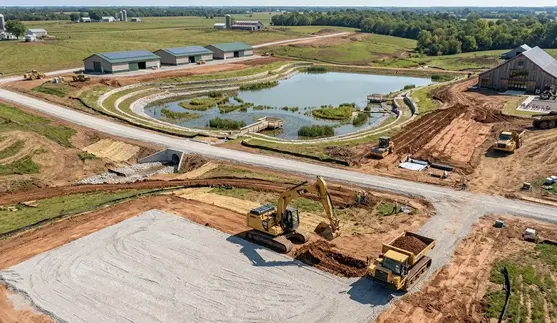
Successful farm development starts with understanding how water, soil, terrain, livestock movement, and equipment access interact across the entire property.
Schedule A Farm Site Walk
Before recommending any pond, road, building pad, drainage correction, or grading project, we evaluate the property as a complete agricultural system. Understanding water flow, soil conditions, access routes, and drainage behavior helps prevent costly mistakes later.
Farm & Ranch Project Pricing Overview
No two farms are the same. Soil type, drainage patterns, access difficulty, equipment requirements, and acreage size all influence cost. But to give North Missouri landowners a realistic starting point, here’s how rural project pricing typically breaks down.
Barn & Equipment Pads
Most pads fall between $3,500–$25,000+ depending on pad size, compaction depth, clay content, and whether we’re building on raw ground or correcting a failed subgrade.
Farm & Livestock Ponds
Typical ranges run $6,000–$40,000+ based on excavation volume, watershed design, clay availability, and whether spillways or overflow controls are required.
Farm & Field Roads
Most roads fall between $2–$8 per linear foot depending on base material, drainage crossings, slope correction, and seasonal access needs.
Drainage & Water Management
Highly site‑specific. Small fixes may be $1,500–$5,000, while full drainage redesigns or erosion control systems can exceed $10,000+.
Land & Fence Line Clearing
Light clearing may run $1,000–$4,000. Heavy timber, steep terrain, or haul‑off requirements can push projects into the $5,000–$20,000+ range.
Ranch Development Projects
Full property development is quoted as a phased plan. Most multi‑acre ranch projects fall between $15,000–$150,000+ depending on grading, water systems, access roads, and infrastructure layout.
Best way to get accurate pricing: On‑site evaluation. We look at drainage flow, soil behavior, access limitations, and intended farm use before giving real numbers.
Farm & Ranch Site Development Service Area
We provide full-service farm and ranch site development across North Missouri, helping landowners turn raw acreage into functional agricultural property. Our work includes barn and equipment pads, livestock pond excavation, pasture and field roads, fence line clearing, drainage correction, and full rural land improvement. Every site is evaluated based on soil conditions, elevation changes, water flow, and long-term land use so your property works efficiently for farming, ranching, and livestock operations.
From undeveloped pasture land to full-scale ranch infrastructure projects, we help transform rural acreage into usable, stable, and productive ground built to handle real farm conditions year-round.
- Liberty, MO
- Smithville, MO
- Plattsburg, MO
- St. Joseph, MO
- Maryville, MO
- Chillicothe, MO
- Trenton, MO
- Hamilton, MO
- Gallatin, MO
- Cameron, MO
- Bethany, MO
- Princeton, MO
- Brookfield, MO
- Macon, MO
- Stanberry, MO
- King City, MO
- Albany, MO
- Jamesport, MO
- Lancaster, MO
- Unionville, MO
- Green City, MO
- Milan, MO
- Savannah, MO
- Rural North Missouri Farms, Ranches & Agricultural Acreage
If you own farm or ranch land anywhere in North Missouri, we can evaluate your property, assess drainage and soil conditions, and build a clear plan to develop stable, usable agricultural ground that supports long-term productivity.
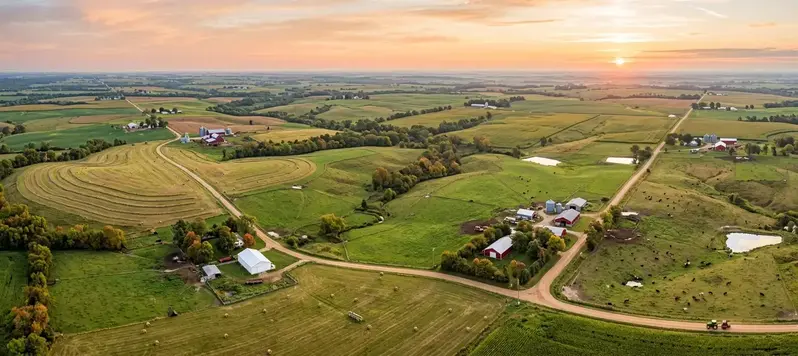
North Missouri's agricultural landscape presents unique opportunities and challenges that require site-specific planning, drainage management, and long-term infrastructure design.
Farm Development Services Across North Missouri
Whether you're building a livestock pond, installing farm roads, preparing a barn pad, correcting drainage issues, or developing raw acreage, we provide excavation solutions tailored to the way your land is actually used.
What Happens During a Farm Site Walk
A proper site walk is not a quick estimate, it’s a ground evaluation process that determines how your land behaves under real agricultural stress.
- We map natural water movement patterns across the property
- Identify load-bearing vs unstable ground zones
- Evaluate access routes for heavy equipment entry
- Check drainage failures and low-point saturation
- Assess soil response to compaction pressure
This is where most project failures are prevented, before a single yard of dirt is moved.
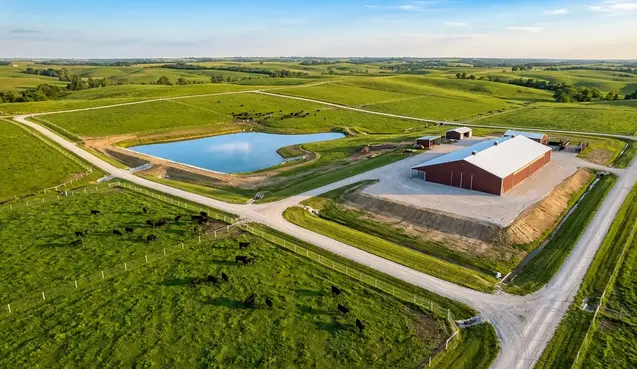
The goal of every project is simple: create farm infrastructure that performs reliably for decades while improving productivity, access, water management, and overall land value.
Don’t Let Small Land Issues Turn Into Expensive Repairs
Most farm and ranch problems don’t show up immediately. They show up after the first heavy rain, the first equipment season, or the first freeze-thaw cycle. By the time a barn pad sinks or a pasture road washes out, the fix is always more expensive than doing it right the first time.
If you’re planning new construction or dealing with drainage, access, or water issues on your land, the safest time to address it is before it becomes a recurring maintenance problem.
Related Excavation Services for Farm & Ranch Properties
Most agricultural development projects require more than one type of excavation. Landowners often combine multiple services to improve access, increase usable acreage, support livestock operations, and reduce long‑term maintenance.
Brush removal, timber clearing, and opening up new acreage for grazing or construction.
Livestock ponds, water retention improvements, dam shaping, and leak correction.
Compacted, properly‑engineered pads for barns, shops, sheds, and agricultural structures.
Gravel access roads, pasture lanes, and all‑weather routes built for equipment and livestock.
Grading, swales, culverts, and runoff correction to protect fields, barns, and infrastructure.
Whether you're developing raw acreage, expanding a cattle operation, improving water retention, or building new agricultural infrastructure, these services work together to create a more productive and efficient farm.
Frequently Asked Questions About Farm & Ranch Site Development in North Missouri
Farm and ranch development is more than just moving dirt. It involves building usable, long-term agricultural ground with proper drainage, stable building pads, livestock-ready infrastructure, pasture access, and erosion control. These are the most common questions we get from landowners developing rural acreage, farms, and ranch properties across North Missouri.
- What does farm and ranch site development actually include?
- It includes everything needed to turn raw acreage into functional working land, barn and shop pads, livestock pond construction, pasture roads, fence line clearing, drainage correction, and general grading. The goal is to make the land usable for farming, ranching, equipment access, and livestock management without long-term maintenance issues.
- Why is proper site preparation important for farms and ranches?
- Without proper grading and drainage, rural land quickly develops problems like standing water, muddy pasture areas, washed-out access roads, and unstable barn pads. In North Missouri’s clay-heavy soil, poor prep leads to long-term erosion and unusable ground that limits farm productivity.
- How do you decide where to place barns, ponds, or access roads?
- We evaluate natural slope, water flow, soil stability, and how the land is used seasonally. Barns and structures are placed on high, stable ground. Ponds are placed in natural watershed areas. Roads are designed to minimize erosion while keeping equipment access efficient year-round.
- What types of farm and ranch projects do you handle?
- We handle livestock pond excavation, barn and equipment pad construction, pasture and gravel road installation, fence line clearing, drainage correction, and full acreage development for farms, ranches, and rural homesteads.
- How important is drainage on rural property?
- It’s one of the most important parts of any farm or ranch project. Poor drainage leads to muddy fields, washed-out driveways, dead pasture areas, and erosion around structures. We design grading and water flow systems that move water away from buildings, roads, and livestock areas to protect usable land.
- Can you build on raw or undeveloped pasture land?
- Yes. Most farm and ranch projects start on raw land. We clear, grade, and stabilize the ground, then build out infrastructure like pads, roads, and drainage systems so the land is ready for agricultural use or construction.
- What causes problems in farm and ranch development projects?
- The most common issues are poor drainage planning, building on unstable soil, not accounting for seasonal water movement, and underbuilding access roads for heavy equipment use. These mistakes lead to long-term maintenance problems and unusable areas of land.
- Do you build livestock ponds and water sources?
- Yes. We excavate livestock ponds, fishing ponds, and water retention systems for farms and ranches. Proper clay shaping, watershed planning, and depth control are used to ensure ponds hold water year-round and support agricultural needs.
- How do you make sure farm roads and pasture access routes last?
- We build roads using proper grading, base compaction, and drainage control so they can handle tractors, trucks, and seasonal weather. Without proper construction, rural roads quickly rut, wash out, and become unusable during wet conditions.
- Can you fix existing farm drainage or erosion problems?
- Yes. We regularly correct issues like standing water in pastures, washed-out driveways, and erosion around barns and fields. Solutions may include regrading, installing drainage channels, building culverts, or reshaping runoff patterns.
- How do I get an accurate estimate for my farm or ranch project?
- Every property is different, so we evaluate soil conditions, acreage size, drainage patterns, access routes, and project goals before pricing. An on-site visit gives the most accurate estimate because it accounts for real land conditions instead of assumptions.
Talk To A Farm Development Contractor
Get experienced guidance for ponds, roads, drainage, barn pads, livestock infrastructure, and complete farm site development projects throughout North Missouri.
Call Now (660) 371-5901